Our pick: the Mr. Heater Portable Buddy, a 4,000/9,000 BTU propane heater with an oxygen depletion sensor (ODS) and a tip-over shut-off, which Mr. Heater rates for “large tents up to 225 sq. ft.” Small tents: Little Buddy. Campsite with power: Honeywell 360° Surround Heater, which burns nothing.
Before you light one: no fuel-burning heater is safe to sleep with. The Consumer Product Safety Commission says not to use portable heaters “while sleeping in enclosed areas such as tents”. Warm the tent, switch the heater off before you sleep, and keep a battery CO alarm inside. Here’s what the agencies say.
| Heater | Best for | Power | Output | Maker’s heating area | Run time | Shut-offs | Weight | Price | |
|---|---|---|---|---|---|---|---|---|---|
| Mr. Heater Portable Buddy (MH9BX) | Best overall | 1 lb propane cylinder | 4,000 / 9,000 BTU | 225 sq ft | 3 h high, 6 h low | ODS, tip-over | 10.6 lb† | $$$ | Check price |
| Mr. Heater Little Buddy (MH4B) | Best for small tents | 1 lb propane cylinder | 3,800 BTU | 95 sq ft | 5.6 h | ODS, tip-over | 5.85 lb† | $$ | Check price |
| Mr. Heater Big Buddy (MH18B) | Best for large tents | Two 1 lb cylinders, or a 20 lb tank on a hose | 4,000 / 9,000 / 18,000 BTU | 450 sq ft | Up to 11 h on two cylinders | ODS, tip-over | 17.1 lb† | $$$ | Check price |
| Honeywell 360° Surround Heater (HHF360) | Best electric heater | 120 V outlet | 750 / 1,500 W | — | Plugged in | Tip-over, overheat | 5.37 lb | $$ | Check price |
| Mr. Heater Electric Buddy (MHBE150FAT) | Best electric for one person | 120 V outlet | 1,500 W (5,118 BTU) | 170 sq ft | Plugged in | Tip-over, overheat | 4 lb† | $$ | Check price |
| Lasko 9″ Ceramic Heater (CD09250) | Best budget electric | 120 V outlet | 900 / 1,500 W | 100 sq ft | Plugged in | Overheat only | 3.18 lb | $ | Check price |
Specs from each maker’s product page, October 2026; run time on one 1 lb cylinder unless stated. Honeywell’s wattage and weight are from HoneywellStore.com, which sells under Honeywell’s license. † = the maker’s store weight, which matches its shipping weight. “—” = not published. Price bands at maker list price: $ under $50 · $$ $50–150 · $$$ over $150.
How we chose
Earlier editions of this guide described these heaters from their makers’ specs. For this October 2026 update (edited by Brian Hamilton), we re-checked all eight earlier picks on their makers’ own sites and read what the CDC, the CPSC and the US Fire Administration say about heaters in tents. That changed the list:
- Dropped: Texsport’s Portable Outdoor Propane Heater. Texsport’s web address is for sale and the store our old page linked lists no heaters. It’s also an outdoor heater with no ODS, and the CPSC says those “must never be used indoors”.
- Dropped: Camplux’s 4,400 BTU butane heater, gone from Camplux’s catalog. Every heater Camplux now sells is labeled an outdoor heater, so there’s no successor.
- Replaced: OPOLAR’s 1,500 W heater is sold out at OPOLAR. The Mr. Heater Electric Buddy, the same kind of ceramic fan heater with a thermostat and tip-over switch, takes its slot.
The three Buddies, the Honeywell and the Lasko stay, with re-checked specs. We left out catalytic heaters (here’s why), and where a maker doesn’t publish a figure, the tables show a dash.
Propane or electric: which tent heater do you need?
It comes down to whether your site has power, and when you want the heat.
| If you… | Get | Why |
|---|---|---|
| Camp with no power and want a warm tent before bed | A propane Buddy | ODS and tip-over shut-off; off before you sleep |
| Have a 120 V hookup | Honeywell, Electric Buddy or Lasko | Nothing burns, so the heater makes no carbon monoxide |
| Only have a power station | Probably no heater | A 1,500 W heater drains a 1,000 Wh station in 40 minutes at most |
| Want heat while you sleep | A warmer sleeping bag and pad | No agency we checked okays sleeping with a heater on |
Our matching, from the maker specs and agency guidance cited on this page, October 2026. Run time math is in the power station table.
Best propane tent heaters
All three are Mr. Heater Buddies, which Mr. Heater calls “indoor safe” and lists for use in tents. Each has an oxygen depletion sensor and a tip-over shut-off. Mr. Heater’s ventilation instructions are in each owner’s manual, not on its product pages, so read the manual before the first use.
1. Mr. Heater Portable Buddy: Best overall

Mr. Heater calls it “North America’s Most Popular Portable Propane Heater”. It rates the MH9BX at 4,000 or 9,000 BTU for “large tents up to 225 sq. ft.”, and a piezo igniter lights it without matches.
A 1 lb cylinder lasts 3 hours on high or 6 on low. For longer trips, a swivel regulator takes a hose and filter to a 20 lb tank, the biggest Mr. Heater has tested it with.
Key specs: 4,000 / 9,000 BTU · heats up to 225 sq ft · 1 lb cylinder, or 20 lb tank with hose and filter · 3 h high, 6 h low · ODS, tip-over shut-off · maximum elevation 7,000 ft · 14.25 × 9 × 15 in · 10.6 lb† · 3-year limited warranty · $$$
Pros
- ODS and tip-over shut-off
- Two heat settings
- Runs on 1 lb cylinders or a 20 lb tank
Cons
- Only 3 hours per cylinder on high
- No thermostat
- Not for use above 7,000 ft
Skip it if: your tent is under 100 sq ft (get the Little Buddy) or your site has power (go electric and skip the combustion).
2. Mr. Heater Little Buddy: Best for small tents

The smallest Buddy screws onto a 1 lb cylinder that stands in an 8-inch round base. Mr. Heater rates its single 3,800 BTU setting for “small enclosed spaces like tents up to 95 sq. ft.” and says it runs 5.6 hours per cylinder.
Key specs: 3,800 BTU · heats up to 95 sq ft · one 1 lb cylinder · 5.6 h · ODS, tip-over shut-off · maximum elevation 7,000 ft · 12 × 9.75 in · 5.85 lb† · 3-year limited warranty · $$
Pros
- Smallest propane pick
- 5.6 hours at full output, against 3 for the Portable Buddy
- ODS and tip-over shut-off
Cons
- One heat setting
- No 20 lb tank option listed
- Not for use above 7,000 ft
Skip it if: your tent floor is over 95 sq ft, a little under 10 × 10 ft. The Portable Buddy covers more than twice that.
3. Mr. Heater Big Buddy: Best for large tents

For wall tents and big cabin tents. Two ceramic tiles give 4,000, 9,000 or 18,000 BTU, which Mr. Heater rates for spaces “like cabins up to 450 sq. ft.” It runs up to 11 hours on two 1 lb cylinders.
High needs both cylinders or a 20 lb tank: Mr. Heater says one cylinder runs only low and medium. It also says tariffs led it to remove the fan “on some models”. The US version was sold out on Mr. Heater’s store in October 2026, though it’s still listed.
Key specs: 4,000 / 9,000 / 18,000 BTU · heats up to 450 sq ft · two 1 lb cylinders, or a 20 lb tank with hose · up to 11 h on two cylinders · ODS, tip-over shut-off · maximum elevation 7,000 ft · 19 × 12 in · 17.1 lb† · 3-year limited warranty · $$$
Pros
- Most output of any pick
- Three heat settings
- ODS and tip-over shut-off
Cons
- Heaviest pick at 17.1 lb
- High needs two cylinders
- Sold out at Mr. Heater at our check
Skip it if: your tent is under 225 sq ft. The Portable Buddy covers that with less weight and cost.
Best electric tent heaters (for sites with hookups)
An electric heater burns nothing, so it makes no carbon monoxide. It still gets hot enough to need clear space around it. None of these three makers mentions tents: they describe rooms, offices and desks.
4. Honeywell 360° Surround Heater: Best electric heater

A barrel-shaped fan heater that blows warm air all the way around, or toward one side on its 180° setting. It has 750 and 1,500 W settings, fan only, and a thermostat that cycles the heat on and off. Our 2019 review warned that the fan makes it “rather noisy”.
The safety kit suits a tent floor: a tip-over switch that trips “if it is tipped in any direction”, an overheat cut-out with a backup thermal fuse, and a cool-touch case. Honeywell says to keep it “at least 3 feet (0.9m) away from any wall or combustible material”.
Key specs: 750 / 1,500 W · fan only · adjustable thermostat · 360° or 180° airflow · tip-over switch, overheat protection, thermal fuse · 8.1 × 11.2 × 7.9 in · 5.37 lb · 3-year limited warranty · $$
Pros
- Heats in every direction
- Tip-over switch trips any way it falls
- Thermostat holds a set temperature
Cons
- Needs a 120 V hookup
- Fan noise, per our 2019 review
- No heating area published
- 3 ft clearance rules out small tents
Skip it if: your site has no power. A power station won’t run it for long (see the runtime table).
5. Mr. Heater Electric Buddy: Best electric for one person
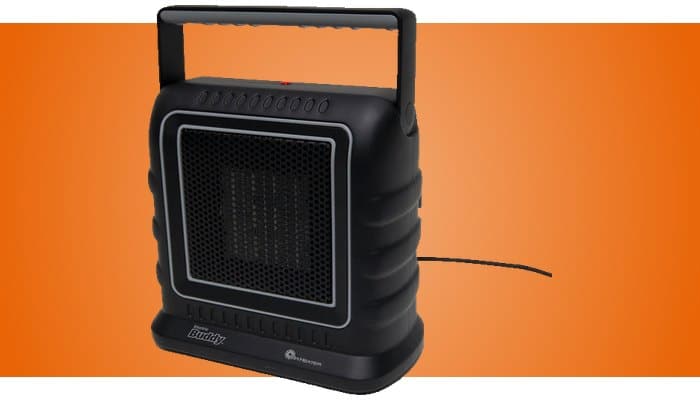
New in this update. We haven’t used this one ourselves; it’s here on its maker’s specs.
Mr. Heater’s plug-in Buddy, sold for “personal indoor heat”. Its ceramic element “delivers radiant heat directly to you”, Mr. Heater says, so it suits one person in a camp chair more than a whole tent. It’s rated at 1,500 W (5,118 BTU) for up to 170 sq ft.
Its low and high heat, fan-only mode, thermostat, tip-over switch and overheat protection match the OPOLAR heater it replaces. The 6-foot cord wraps up for packing.
Key specs: 1,500 W (5,118 BTU) · low / high + fan only · adjustable thermostat · heats up to 170 sq ft · tip-over switch, overheat protection · 6 ft cord · 6.14 × 10.35 × 13.82 in · 4 lb† · 1-year limited warranty · $$
Pros
- Tip-over switch and overheat protection
- Thermostat and fan-only mode
- Lighter than the Honeywell
Cons
- 1-year warranty, against 3 for the others
- Low-setting wattage not published
- Aims heat one way
Skip it if: you want to warm a family tent evenly. The Honeywell blows heat all around.
6. Lasko 9″ Ceramic Space Heater (CD09250): Best budget electric

The cheapest and smallest heater here, at 9.2 inches tall and 3.18 lb, with 1,500 W high, 900 W low and fan only. It adds an 11-step thermostat, overheat protection, a cool-touch case and an ETL listing.
The catch: Lasko lists no tip-over switch on this model, which it sells for “desktops, offices, and dorm rooms”. Its 9-inch CD09475 adds one.
Key specs: 900 / 1,500 W + fan only · 11-setting thermostat · heats up to 100 sq ft · overheat protection, cool-touch housing · no tip-over switch listed · 6 ft cord · 9.2 × 6 × 7 in · 3.18 lb · ETL listed · 3-year limited warranty · $
Pros
- Lowest price band
- Smallest and lightest pick
- Fine-grained thermostat
Cons
- No tip-over switch listed
- Smallest heating area of the electrics
- Made for a desk, not a floor
Skip it if: kids or dogs share the tent, or the floor is soft or sloping. Pay more for the Honeywell’s tip-over switch.
Is it safe to sleep with a heater in a tent?
No: none of the agencies we checked supports sleeping with a heater on. The CPSC and the US Fire Administration say to switch heaters off at bedtime, electric space heaters included. The CDC warns that sleeping people can die of CO poisoning “before they have symptoms”.
They differ on one point. A 1999 CDC report says camping heaters don’t belong in a tent at all, while the CPSC says ODS heaters can be used if you follow the maker’s ventilation instructions.
| Agency | What it says |
|---|---|
| CPSC, Portable Heaters & Camping Equipment | “Do not use portable heaters or lanterns while sleeping in enclosed areas such as tents, campers, and other vehicles.” The risk of CO poisoning is “increased” at high altitudes. |
| CPSC, release on ODS heaters (October 2002) | ODS heaters “can be safely used inside tents, cabins, and campers, but it is essential that users comply with the manufacturers’ instructions to ensure that there is adequate ventilation.” Still, “CPSC still recommends shutting off any camping heater or lantern before going to sleep.” Heaters without an ODS “must never be used indoors.” |
| CPSC, Carbon Monoxide Questions and Answers | “Never use portable fuel-burning camping equipment inside a home, garage, vehicle or tent unless it is specifically designed for use in an enclosed space and provides instructions for safe use in an enclosed area.” |
| CDC, report on camping deaths in Georgia (1999) | Fuel-burning equipment, including camping heaters, “should never be used inside a tent, camper, or other enclosed shelter.” And: “Opening tent flaps, doors, or windows is insufficient to prevent build-up of CO concentrations from these devices.” |
| CDC, Carbon Monoxide Poisoning Basics (January 2026) | “Never use a portable gas camp stove indoors.” “Do not use portable flameless chemical heaters indoors.” |
| US Fire Administration, Heating Fire Safety | “Keep anything that can burn at least 3 feet from all heat sources.” “Turn space heaters off when leaving the room or going to bed.” |
Quotes from each agency’s own page, read October 2026: CPSC Portable Heaters & Camping Equipment, release 03-021 and CO Q&A; CDC MMWR, Georgia, March 1999 and CO Poisoning Basics; USFA Heating Fire Safety (reviewed May 2023).
So if you use a propane heater in a tent, use only one with an ODS, set it up exactly as its manual says, and run it while you’re awake. Switch it off before you zip into your bag. Our camping safety tips cover the rest of camp.

What an oxygen depletion sensor does: the CPSC describes it as a sensor that notices when oxygen in a tent or camper “drops below 18 percent”, then shuts the gas off. It measures oxygen, not carbon monoxide, so it’s no CO alarm: it can’t wake you, and it does nothing about CO from anything else in the tent.
What do tent heater makers say about indoor use?
Mr. Heater is the only maker here that names tents. The electric makers describe homes, offices and desks.
| Heater | Maker’s wording | ODS | Tip-over shut-off |
|---|---|---|---|
| Portable Buddy | “Enclosed spaces like large tents up to 225 sq. ft.”; indoor-safe: yes | Yes | Yes |
| Little Buddy | “Small enclosed spaces like tents up to 95 sq. ft.”; indoor-safe: yes | Yes | Yes |
| Big Buddy | “Enclosed spaces like cabins up to 450 sq. ft.”; indoor-safe: yes | Yes | Yes |
| Honeywell 360° Surround | “Small to mid-sized rooms”; 3 ft from “any wall or combustible material” | n/a | Yes, any direction |
| Electric Buddy | “Indoor-safe heat for your home or office” | n/a | Yes |
| Lasko CD09250 | “Desktops, offices, and dorm rooms”; use case: indoor | n/a | Not listed |
Wording from each maker’s product page or FAQ, October 2026. Mr. Heater’s ventilation requirements are in its owner’s manuals, which we haven’t quoted here. “n/a” = electric, nothing to burn.
Even Mr. Heater’s indoor rating has limits. Its FAQ says the Buddies are “Restricted from all indoor use in Massachusetts and Canada” and “Restricted from use in dwellings in California”.
Do you need a carbon monoxide detector in a tent?
Yes, whenever anything in the tent burns fuel. As First Alert puts it, carbon monoxide “can’t be seen or smelled”, so an alarm is your only warning. What to look for, from the agencies:
- Battery power. The CDC recommends “battery-operated or battery back-up CO detectors near every sleeping area”.
- A UL 2034 listing. The CPSC says to buy one “that meets the requirements of the current UL 2034 safety standard.”
- A digital readout if you can. The CDC says it can “tell you the highest level of CO concentration”.
- One rated for RVs if you camp in one too. The CPSC says RV alarms “are available” and “should be used.”
- Replacement “following the manufacturer’s instructions or every 5 years”, says the CDC.
One example is First Alert’s CO1-B01RVA, a 9 V battery alarm “listed for both recreational vehicles and home use”. It was backordered at First Alert when we checked. Whichever you buy, check its operating temperature range in the manual before you rely on it in a cold tent.
An alarm is a backstop. It doesn’t make it safe to sleep with the heater on.
What size heater do you need for a tent?
Mr. Heater gives a rule: “Square Footage x 40 = required BTUs.” It calls that “just a starting point”, because insulation changes the answer, and a tent has almost none. Every propane Buddy’s heating area follows the rule exactly.
| Tent floor | Area | Mr. Heater’s rule | Buddy that fits |
|---|---|---|---|
| 7 × 7 ft | 49 sq ft | 1,960 BTU | None: 3 ft of clearance leaves no room to sleep |
| 8 × 10 ft | 80 sq ft | 3,200 BTU | Little Buddy (3,800 BTU) |
| 10 × 10 ft | 100 sq ft | 4,000 BTU | Portable Buddy on low |
| 10 × 14 ft | 140 sq ft | 5,600 BTU | Portable Buddy (4,000 / 9,000 BTU) |
| 16 × 20 ft | 320 sq ft | 12,800 BTU | Big Buddy (9,000 / 18,000 BTU) |
Area = length × width; BTU = area × 40, Mr. Heater’s rule from its Buddy FAQ, October 2026. Its heating areas match: 9,000 ÷ 225, 3,800 ÷ 95, 18,000 ÷ 450 and the Hunting Buddy’s 12,000 ÷ 300 all equal 40.
Electric ratings follow no shared rule: Mr. Heater rates its 1,500 W Electric Buddy for 170 sq ft, and Lasko its 1,500 W heater for 100. Treat any heating area as a rough guide.
Clearance matters more than output. Keeping the USFA’s 3 feet clear on every side takes a patch of floor about 7 feet across, with no sleeping bags in it. Measure your tent first.
Did you know? A 1,500 W electric heater on high puts out more heat than the propane Little Buddy. By Mr. Heater’s own figures, its Electric Buddy makes 5,118 BTU and the Little Buddy 3,800. Electric heat falls short only where the power runs out.
Do propane tent heaters work in the cold and at altitude?
In hard cold, the 1 lb cylinder is the weak point. Mr. Heater’s FAQ says propane boils at −44°F (−42°C), and in very cold weather a small cylinder can’t make gas fast enough, so it frosts over and the heater shuts off. Mr. Heater’s fix is a bigger tank on a hose.
Altitude is a hard limit. Every Buddy lists a maximum elevation of 7,000 ft, and the CPSC says the risk of CO poisoning is “increased” at high altitudes. Above that, go electric or go without.
Are catalytic heaters safe in a tent?
Some tent heater guides call them the safer choice. The CDC’s list says: “Do not use portable flameless chemical heaters indoors.” Catalytic heaters are flameless, but they still burn fuel: Mr. Heater says its Journey heater “utilizes a catalytic medium to completely and efficiently burn gas”.
Mr. Heater also calls the Journey “the only line of catalytic heaters with an Oxygen Depletion Sensor”, so by its account others have none. We’ve left catalytic heaters off this list.
Can a power station run a tent heater?
Not for long. Divide the station’s watt-hours by the heater’s watts for the most you’ll get.
| Power station | 1,500 W (any pick on high) | 900 W (Lasko on low) | 750 W (Honeywell on low) |
|---|---|---|---|
| 500 Wh | 20 min | 33 min | 40 min |
| 1,000 Wh | 40 min | 67 min | 80 min |
| 2,000 Wh | 80 min | 2 h 13 min | 2 h 40 min |
Our math: watt-hours ÷ heater watts × 60. These are upper limits: some energy is lost turning battery power into 120 V, and the station must supply 1,500 W continuously. Heater wattages from Lasko and HoneywellStore.com, October 2026.
At a site with a hookup, the power comes from the post. The US Fire Administration says to plug space heaters “directly into wall outlets and never into an extension cord or power strip”.
A tent’s outlet is on a post outside, so read your heater’s manual on cords and ask the campground what it allows. To charge gear instead, see our portable solar generators.
How do you stay warm in a tent without a heater?
Warm yourself, not the air. After the 1999 deaths, the CDC’s advice was that campers “should leave home with adequate bedding and clothing” and “consume extra calories and fluids” rather than rely on fuel-burning heat.
- A sleeping bag rated for the night’s low: our guide to choosing a sleeping bag explains the ratings.
- A camping cot and an insulated pad to get you off the cold ground.
- With a hookup, an electric blanket warms you instead of the tent.
- Without one, hand warmers and heated socks.
Use the heater to take the chill off while you change and settle in, then switch it off. More cold-night planning is in our winter camping guide.

Just bought the Mr. Heater Big Buddy for our family camping trip. Can’t wait to try it out in our large tent!
I recently purchased the Texsport Portable Outdoor Propane Heater for my solo hiking trips. It’s lightweight and easy to carry, which is essential for me. The heat output is decent for small tents, but the lack of an automatic ignition is a minor drawback. Overall, a solid 4/5 for its portability and efficiency.