Our pick: the Black Diamond Guide Gloves, a GORE-TEX glove with a removable liner that Black Diamond rates for −15 to 0°F (−26 to −18°C). Coldest days: Outdoor Research Alti GORE-TEX Mitt. Budget: Kinco 901. Wet hands: Showa TemRes 282-02.
About “rated to −30°F”: no common test sits behind those numbers. The European cold-glove standard, EN 511, gives test levels, not temperatures. Here’s how to read each rating.
Pick a style for what you’ll be doing with your hands, then a glove. Our activity table matches both to how cold it gets.
| Glove | Best for | Type | Waterproof layer | EN 511 | Maker’s own rating | Price | |
|---|---|---|---|---|---|---|---|
| Black Diamond Guide Gloves | Best overall | Glove, removable liner | GORE-TEX insert | — | Temp range −26/−18 C (−15/0 F) | $$$ | Check price |
| Outdoor Research Alti GORE-TEX Mitt | Best for the coldest days | Mitt, removable liner mitt | GORE-TEX shell | — | Warmth 5 of 5 (OR’s scale) | $$$$ | Check price |
| Hestra Army Leather Heli Ski 3-Finger | Best 3-finger (lobster) | 3-finger, removable lining | None (water-resistant shell) | — | Warmth 7 of 8, “Extreme” (Hestra’s scale) | $$$ | Check price |
| Gordini AquaBloc Down Gauntlet Mitt | Best value mitten | Mitt | AquaBloc insert | — | — | $$ | Check price |
| Kinco 901 Lined Pigskin Ski Glove | Best budget | Leather work glove | None (wax included) | — | — | $ | Check price |
| Showa TemRes 282-02 | Best for wet cold and ice fishing | Coated work glove | Polyurethane coating | 021 | — | — | Check price |
| Vallerret Skadi LRS Zipper Mitt | Best for photography | Zip-open mitt, removable liner | — (water-repellent shell) | — | “Deep Winter” (Vallerret’s scale) | $$ | Check price |
| Outdoor Research Prevail Heated GORE-TEX Mitt | Best heated | Heated mitt | GORE-TEX insert | — | Warmth 5 of 5 (OR’s scale) | $$$$ | Check price |
Specs and ratings from each maker’s product page, October 2026, as published; “—” = none published. EN 511 is a European test standard; every other rating is the maker’s own. Price bands at the maker’s US list price: $ under $60 · $$ $60–150 · $$$ $150–250 · $$$$ over $250. Showa sells through distributors and lists no price.
How we chose
None of us has used these gloves, and each card says so. For this October 2026 page (edited by Brian Hamilton), we read the top-ranking “best gloves for extreme cold” guides, then checked every pick on its maker’s own site: still sold, insulation, waterproof layer and any published rating.
We kept to makers with real cold-weather lines that publish full specs. That ruled out:
- The Amazon-sold brands that fill the two top-ranking lists we read. Their “−30°F”-style claims come from their listings, with no test method stated.
- The North Face, Carhartt and Mountain Hardwear gloves: their sites blocked our checks, so we couldn’t confirm specs or stock.
- More than one heated glove. Our heated gloves guide covers those.
Best gloves and mittens for extreme cold
These four are built for skiing, winter climbing and long days below freezing. Three have removable liners, so you can swap out a damp one or wear the liner alone.
1. Black Diamond Guide Gloves: Best overall
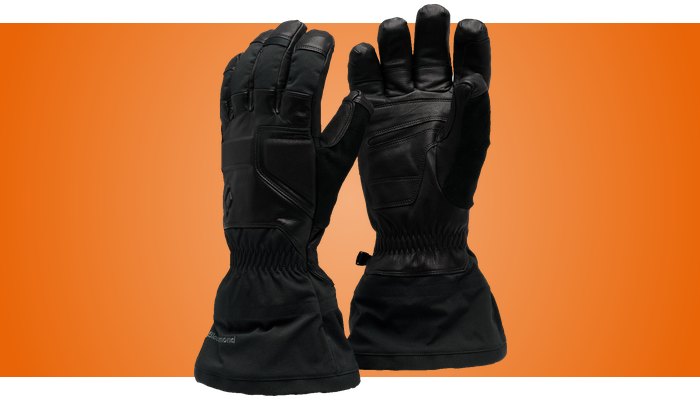
New in this update. We haven’t used this one ourselves; it’s here on its maker’s specs.
Black Diamond calls the Guide its “warmest ski gloves,” designed for winter professionals working all season. As a glove, it leaves each finger free for buckles, zips and ski straps.
Warmth comes in layers: 170 g PrimaLoft Gold Cross Core on the back of the hand, plus a removable high-loft wool-blend liner. A GORE-TEX insert keeps water out, and the goatskin palm and back are built for “season after season in harsh mountain conditions.”
It’s also one of few gloves with a published temperature range: −15 to 0°F (−26 to −18°C). The latest redesign added darted fingers, which Black Diamond says shorten the break-in.
Key specs: 170 g PrimaLoft Gold Cross Core back, Y-Warm palm · removable wool-blend liner · GORE-TEX insert · goatskin palm and back · gauntlet with cinch cord, wrist leash · 299–356 g by size · XS–XXL (women’s version too) · Nikwax included · $$$
Pros
- Published temperature range
- Removable liner
- Waterproof GORE-TEX insert
- Glove dexterity
Cons
- A glove, so less warm than a mitt with the same insulation
- $$$ band
- Black Diamond doesn’t say how it sets its ranges
Skip it if: you’ll stand still for hours below 0°F. Take the Alti mitt or a heated mitt.
2. Outdoor Research Alti GORE-TEX Mitt: Best for the coldest days
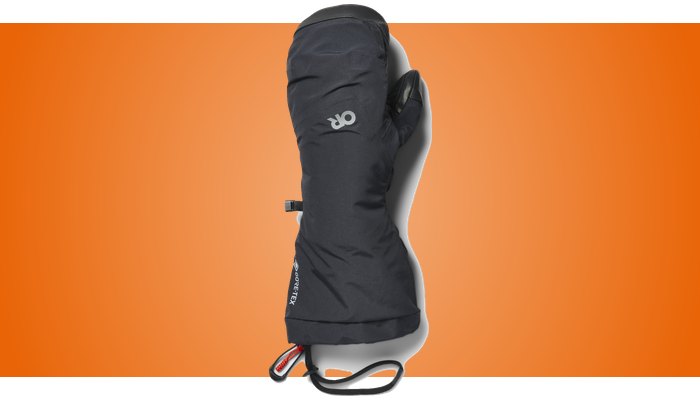
New in this update. We haven’t used this one ourselves; it’s here on its maker’s specs.
Outdoor Research built the Alti for “high-altitude mountaineering, 8,000-meter climbs, and expedition use,” and calls it “the warmest protection in the collection.” The mitt was updated for 2026.
The shell is GORE-TEX with PrimaLoft Gold, and a removable insulated liner mitt adds more PrimaLoft Gold on the back of the hand. A goat-leather palm, Kevlar stitching and a cinchable gauntlet round it out.
OR gives no temperature, only its own warmth scale, where the Alti scores 5 of 5.
Key specs: GORE-TEX 2L shell, 70D recycled nylon · PrimaLoft Gold Cross Core, 170 g in the shell, 340 g in the liner (back of hand) · VerticalX Octa insulation · removable liner mitt · goat-leather palm · leash, glove clip, carabiner loop · 12.3 oz (349 g) · S–XL (women’s version too) · $$$$
Pros
- OR’s warmest handwear
- Removable insulated liner mitt
- GORE-TEX shell
Cons
- Priciest non-heated pick
- Mitt: off for fine tasks
- No temperature published
Skip it if: you’re clearing a driveway or skiing a resort. The Gordini mitt costs far less.
3. Hestra Army Leather Heli Ski 3-Finger: Best 3-finger (lobster)
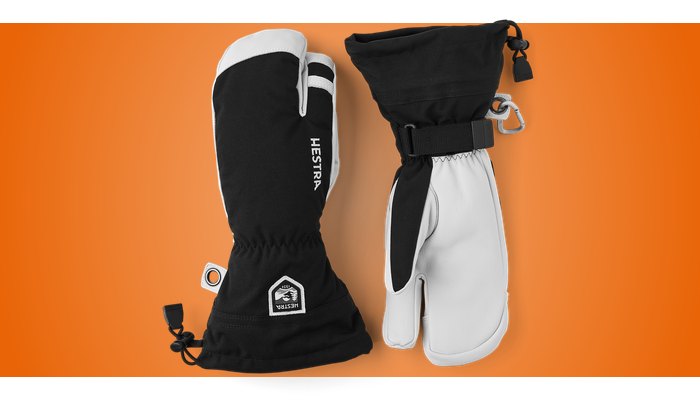
New in this update. We haven’t used this one ourselves; it’s here on its maker’s specs.
Hestra first made the Heli Ski for ski guides in western Canada. The 3-finger version keeps your thumb and index finger separate and the other three together. Hestra pitches it at people who want “more warmth” but still need to work with their fingers.
It has a goat-leather palm, Hestra’s Triton polyamide back and G-Loft insulation. The 3-finger lining comes out if it gets damp, and a snow lock and wrist strap seal the cuff.
On Hestra’s 8-step warmth scale it’s a 7, “Extreme.” But Hestra lists it as not waterproof: no membrane, so it isn’t built to keep hands dry in sustained wet.
Key specs: goat-leather palm · Triton polyamide back (windproof, water-resistant) · G-Loft insulation · removable 3-finger lining · snow lock, wrist strap, carabiner · no waterproof membrane · Hestra sizes 5–12 in black · $$$
Pros
- Index finger free for poles and zips
- Hestra’s second-warmest rating
- Removable lining
- Sizes 5 to 12
Cons
- No waterproof membrane
- Hestra scores its mobility 4 of 8
- $$$ band
Skip it if: you ski wet snow or spring slush. The Guide Gloves have a GORE-TEX insert.
4. Gordini AquaBloc Down Gauntlet Mitt: Best value mitten
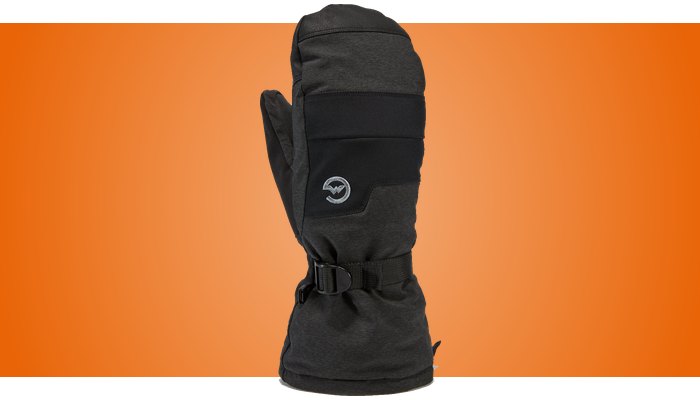
New in this update. We haven’t used this one ourselves; it’s here on its maker’s specs.
A full mitt in the $$ band: 600-fill goose down throughout, inside a waterproof, windproof AquaBloc insert. Gordini calls it “your best defense against the cold.”
The shell is stretch-woven taslan with softshell trim. A long gauntlet with a drawcord and wrist strap seals the cuff, and there’s a nose wipe. Gordini publishes no temperature or warmth rating.
Key specs: 600-fill goose down · AquaBloc waterproof, windproof, breathable insert · stretch-woven taslan shell · gauntlet with drawcord and wrist strap · S–XXL (women’s version too) · no rating published · $$
Pros
- Cheapest mitt among our picks
- Waterproof insert
- Sizes to XXL
Cons
- No rating of any kind
- No removable liner listed
- Mitt: off for fine tasks
Skip it if: you need your fingers every few minutes. The Hestra 3-finger or the Vallerret is easier.
Best cold-weather work gloves
For shoveling, splitting wood and handling wet, frozen gear. One is leather, one is coated, and the coated one is the only glove here tested to EN 511.
5. Kinco 901 Lined Pigskin Ski Glove: Best budget
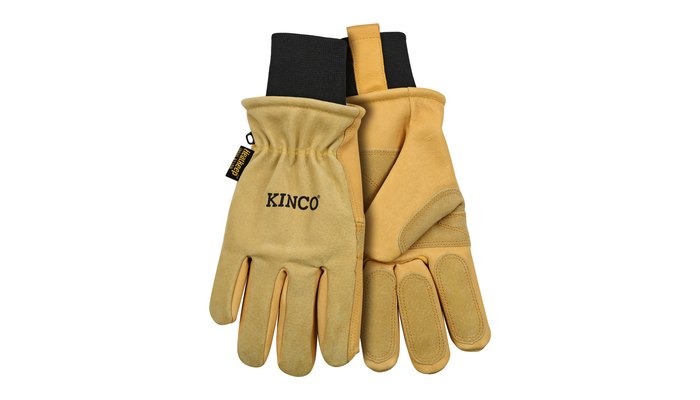
New in this update. We haven’t used this one ourselves; it’s here on its maker’s specs.
The lowest price band here, and Kinco lists snow and ice removal, farm work and wood chopping among its uses. It’s grain and suede pigskin, with Kinco’s heavyweight Heatkeep insulation and a neoprene layer on the back of the hand.
There’s no membrane. Kinco includes a packet of Nikwax Waterproofing Wax for Leather “to shield you from wet conditions,” so waterproofing is a job you do. The knit Omni-Cuff can be worn inside or outside the glove, and Kinco makes the same build as a mitt, the 901T.
Key specs: grain pigskin palm, suede pigskin back · heavyweight Heatkeep insulation · neoprene back-of-hand layer · knit Omni-Cuff · Nikwax wax included · S–XL · no rating published · $
Pros
- Lowest price band
- Leather grips tools and handles
- Wax included
Cons
- No waterproof membrane
- No rating of any kind
- Lining is built in
Skip it if: your hands go in slush or water. The Showa is coated.
6. Showa TemRes 282-02: Best for wet cold and ice fishing
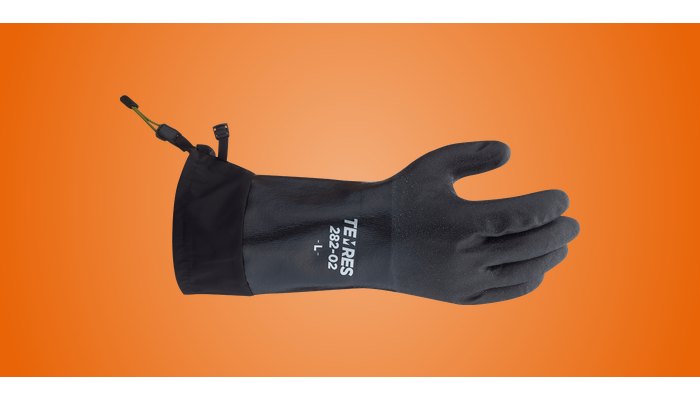
New in this update. We haven’t used this one ourselves; it’s here on its maker’s specs.
A polyurethane-coated glove over a fixed acrylic liner, with a 13 in (328 mm) cuff that cinches with a drawcord and buckle. Showa calls it “water-resistant yet breathable” and lists hunting and winter sport among its uses.
It’s the only pick tested to EN 511, rated 021. That’s 0 for convective cold, 2 for contact cold and 1, a pass, for water.
So it suits handling wet, cold things, like ice-fishing gear or a shovel in slush. It isn’t the glove for standing in cold wind.
Key specs: EN 511:2006 021 · EN 388 4221X · fixed insulated acrylic liner, fleece lining · polyurethane coating, rough grip · 13 in (328 mm) with drawcord and side-release buckle · sizes 8/M to 11/XXL · price not published
Pros
- Passed EN 511’s water test
- Long cuff keeps slush out
- Grip for wet, icy handles
Cons
- Convective cold 0, the bottom of the scale
- Liner can’t come out to dry
- No small size
Skip it if: your hands stay dry. The Kinco or a mitt is warmer in the wind.
Best for dexterity and for poor circulation
Two answers to cold fingers: open the mitt for a few seconds, or add battery heat.
7. Vallerret Skadi LRS Zipper Mitt: Best for photography
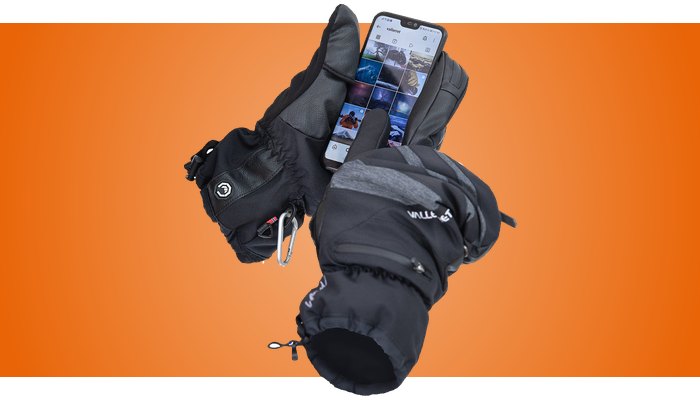
New in this update. We haven’t used this one ourselves; it’s here on its maker’s specs.
Vallerret makes cold-weather gloves for photographers. The Skadi is a 2-in-1: a mitt that unzips to free your fingers, with a magnetic flip-top thumb, over a removable Polartec Power Stretch Pro liner. The liner has touchscreen fingertips.
The mitt has PrimaLoft Gold insulation and a merino wool lining. A storm leash, a carabiner and a tripod key in the back pocket are included.
Vallerret rates it “Deep Winter,” the fourth of its five levels, without a temperature. It lists a water-repellent shell, not a waterproof membrane.
Key specs: zip-open mitt, magnetic flip-top thumb · removable Polartec Power Stretch Pro liner, touchscreen finger and thumb · PrimaLoft Gold, 100% merino lining · DWR laminated twill shell · storm leash, carabiner, tripod key · XS–XXL · “Deep Winter” · $$
Pros
- Fingers out without taking it off
- Liner works a touchscreen
- Tripod key built in
Cons
- No waterproof membrane listed
- “Deep Winter” has no temperature
- Costs more than the Gordini mitt
Skip it if: you never need bare-ish fingers. The Gordini mitt costs less.
8. Outdoor Research Prevail Heated GORE-TEX Mitt: Best heated
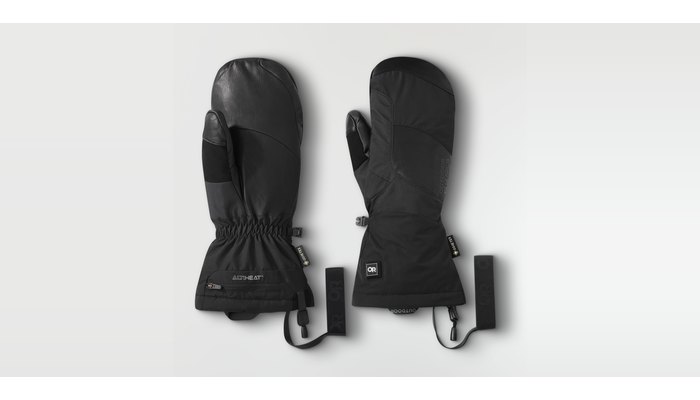
New in this update. We haven’t used this one ourselves; it’s here on its maker’s specs.
An insulated GORE-TEX mitt with OR’s ALTIHeat battery heating. It runs on two 7.4 V lithium-ion packs, and OR gives an average of 8 hours on low, 5 on medium and 2.5 on high.
OR’s warnings matter. Don’t use it with an avalanche beacon: OR says electrically heated gloves interfere with beacons. If diabetes, Raynaud’s or similar dulls your sense of heat, OR says ask your doctor first.
Key specs: ALTIHeat heating, two 7.4 V lithium-ion packs · about 8 h low, 5 h medium, 2.5 h high (OR’s average) · EnduraLoft insulation · GORE-TEX insert · goat-leather palm · touchscreen compatible · 10.6 oz (301 g) · unisex XS–XL · OR warmth 5 of 5 · $$$$
Pros
- Heat when insulation isn’t enough
- Insulated and waterproof with the batteries off
- Run times published
Cons
- Most expensive pick
- 2.5 hours on high
- Not for use with an avalanche beacon
Skip it if: you ski the backcountry with a beacon. Take the Alti. For more heated options, see our best heated gloves.
What do glove temperature ratings mean?
Usually, whatever the maker decides. There’s one real test standard, EN 511, and only one of our picks carries it. Everyone else uses a range or a scale of their own, so the numbers can’t be compared across brands.
What EN 511 means: EN 511:2006 is the European standard for protective gloves against cold, down to −50°C (−58°F). A tested glove shows a pictogram with three digits, in this order (test methods as SATRA, a lab that certifies to it, describes them):
- Convective cold, 0 to 4: insulation against cold air, measured on an electrically heated hand in a cold chamber.
- Contact cold, 0 to 4: resistance to cold from touching cold objects, measured between a warm and a cold plate.
- Water penetration, 0 or 1: a tester wears the glove in water to the wrist; 1 is a pass.
Higher is better, and an X means that test wasn’t done. The standard’s own summary is blunt: “Product tests may only give performance levels and not levels of protection.” No level equals a temperature.
| Kind of rating | Our picks, as published | What it tells you | What it doesn’t |
|---|---|---|---|
| EN 511 code | Showa TemRes 282-02: “EN 511:2006 021” | Lab results on a common scale | A safe temperature: no level equals one |
| Maker’s temperature range | Black Diamond Guide Gloves: “Temp Range: -26/-18 C (-15/0 F)” | Where the maker expects it to be comfortable | How it was set; Black Diamond doesn’t say |
| Maker’s warmth scale | Hestra Heli Ski 3-Finger: 7 of 8, “Extreme” · OR Alti and Prevail: 5 of 5 · Vallerret Skadi: “Deep Winter,” 4 of 5 | Rank within that maker’s range | Anything across brands: Hestra’s 7 of 8 and OR’s 5 of 5 aren’t the same thing |
| None published | Gordini AquaBloc, Kinco 901 | — | — |
| “Rated to −30°F” on a listing | None of our picks | The seller’s claim | Any test method we could find |
Ratings copied from each maker’s product page, October 2026. EN 511 sources: Austrian Standards’ summary of EN 511:2006 (scope, “levels of protection” quote), SATRA (test methods), ATG and Watson Gloves (digit order, X).
Did you know? Black Diamond gives its Guide Gloves and its Mercury Mitts the same range, −15 to 0°F (−26 to −18°C), though weather and medical guidance says mitts are warmer. Black Diamond doesn’t say how it sets its ranges, so treat one as the maker’s guide, not a test result.
Use a rating to compare within a brand, not between brands. OR scores both its 8,000 m expedition mitt and its heated mitt 5 of 5, the top of its scale. Its scale can’t tell you which is warmer.
Are mittens warmer than gloves?
Yes, with the same insulation. The National Weather Service’s cold-weather advice says “Mittens are better than gloves,” and the Wilderness Medical Society’s frostbite guidelines list “wearing mitts instead of gloves” as a way to add insulation.
The usual explanation: in a mitten your fingers share one pocket of warm air, with less outer surface losing heat than four separate fingers. The cost is dexterity, which is why the in-between styles exist.
| Style | Warmth | Dexterity | Best for | Our picks |
|---|---|---|---|---|
| Mitten | Warmest for its insulation | Lowest; off for fine tasks | The coldest days, standing still, cold-prone hands | OR Alti, Gordini AquaBloc |
| 3-finger (lobster) | Between mitt and glove | Thumb and index finger free | Skiing, poles, zips, buckles | Hestra Heli Ski 3-Finger |
| Glove | Least warm for its insulation | Highest | Work, tools, active days | BD Guide, Kinco 901, Showa 282-02 |
| Liner plus shell | Adjustable: add or remove the liner | Liner alone for fine tasks | Changing temperatures, hard effort, cameras | BD Guide, OR Alti, Hestra, Vallerret Skadi |
| Heated | Battery heat on top of insulation | Depends on the shell | Long sits, poor circulation | OR Prevail Heated Mitt |
Mitts over gloves: National Weather Service and the Wilderness Medical Society’s frostbite guidelines (as summarized by American Family Physician). The 3-finger’s place and the liner uses come from Hestra’s, Black Diamond’s and Vallerret’s product pages, October 2026.
Which gloves for shoveling, skiing, ice fishing or photography?
Start with what your hands will do, then how cold it gets. Below 0°F, or in wind, move one step warmer.
| You’re… | Down to about 0°F (−18°C) | Below 0°F, or windy | Why |
|---|---|---|---|
| Shoveling, chores, splitting wood | Kinco 901 | Kinco’s mitt version, the 901T, or a mitt for breaks | Leather grips tools; Kinco lists snow removal among its uses |
| Ice fishing, or working in slush | Showa 282-02 for handling | Showa for handling, a mitt for waiting | Showa passed EN 511’s water test, but scored 0 for cold air |
| Skiing at a resort | Hestra 3-Finger or BD Guide | Gordini or OR Alti mitt | Mitts are warmer; the 3-finger keeps a finger free for poles |
| Backcountry skiing, winter hiking, climbing | BD Guide; liner alone on the climb | OR Alti over a liner at stops | Hestra says its liner comes out when damp or to suit your effort; OR says heated gloves interfere with avalanche beacons |
| Photography, drones, fine tasks | Vallerret Skadi | Vallerret Skadi, fingers out only briefly | Unzip for the shot, then close it; the liner works a touchscreen |
| Sitting still for hours, or cold-prone hands | Gordini mitt | OR Prevail Heated Mitt | Battery heat on top of insulation; ask a doctor first if you have Raynaud’s |
Our matching from the makers’ specs, October 2026. The 0°F line is our rule of thumb, not a standard. For scale: at 0°F with a 15 mph wind, the National Weather Service puts the wind chill at −19°F, cold enough to freeze exposed skin in 30 minutes.
Are heated gloves worth it for extreme cold?
For long sits and cold-prone hands, often yes; for everything else, a warmer mitt is simpler. Battery heat runs out: OR’s packs average 2.5 hours on high. Carry spares or use the low setting.
Two cautions. OR warns that heated gloves interfere with avalanche beacons, so leave them at home on backcountry days. And buy from a maker you can check: in July 2025 the CPSC told owners of Velazzio Thermo1 heated gloves, sold on Amazon, to stop using them after 137 overheating reports and 119 burns.
Our heated gloves guide compares more models. For a cheaper boost, a warmer inside a mitt helps: see our hand warmer picks.
How should extreme cold gloves fit?
Snug enough to grip, loose enough not to squeeze. The Wilderness Medical Society lists “minimizing blood flow constriction caused by tight clothing or footwear” as part of frostbite prevention, so leave room for a liner.
- Outdoor Research: measure around the knuckles (not the thumb) and from the base of the palm to the tip of the middle finger. Use the larger size.
- Hestra: measure around the widest part of the palm; some models fit tighter than others.
- Vallerret: at the top of a size range and wearing liners often? Size up, though a looser fit costs some camera control.
Do you need extreme cold weather gloves?
Not for 20 minutes with a shovel at 25°F. The Kinco or the Gordini mitt covers ordinary winter chores and resort days. The $$$$ picks are built for hours out below 0°F; OR designed the Alti for 8,000 m peaks.
When it’s dangerously cold, gear isn’t the answer. The National Weather Service says: “To avoid frostbite, stay inside during severe cold, especially when the windchill is -50°F or below.”
Shooting in winter? Our tactical gloves are thin shooting gloves, so pair one with a mitt between strings.
Spending nights out? Our winter camping guide covers the rest of the kit.
