Our first pick for mechanics is the Gerber Center-Drive when screwdriving dominates. Choose the Dual-Force for its adjustable pliers, the Surge for a fuller repair kit, or the Skeletool CX for lighter pocket carry. These are portable repair companions; keep dedicated sockets, wrenches and torque tools for the jobs that require them.
A good mechanic’s multi-tool needs to match the work between visits to the toolbox. Driver reach, bit compatibility and plier shape are more useful selection criteria than the largest advertised tool count. This guide covers folding hand tools, not powered oscillating multi-tools.
On a small screen, swipe the comparison table sideways to see every column.
| Multi-tool | Best fit | Listed tool weight | Driver arrangement | Band |
|---|---|---|---|---|
| Gerber Center-Drive | Frequent screws | 9.5 oz | Standard 1/4-inch bits | $$ |
| Gerber Dual-Force | Broader gripping jobs | 12 oz | Standard 1/4-inch bits | $$ |
| Leatherman Surge | Wide repair selection | 12.5 oz | Flat bits; adapter for standard bits | $$ |
| Leatherman Rebar | Simple fixed-driver kit | 6.65 oz | Fixed tips; optional removable bit driver | $ |
| Leatherman Skeletool CX | Pocket carry | 5 oz | Flat bits; adapter for standard bits | $ |
| Spirit X Plus Ratchet | Separate ratchet kit | 7.4 oz listed; kit basis unclear | Separate ratchet and bit set | $$$ |
Manufacturer specifications checked October 2026. Weights exclude extra carry equipment unless explicitly stated; the Victorinox figure has an unresolved kit boundary. Price bands: $ under $100; $$ $100–175; $$$ over $175, based on maker listings before tax and accessories.
Which multi-tool fits a mechanic’s everyday jobs?
1. Gerber Center-Drive Bit Set: Best for frequent screwdriving
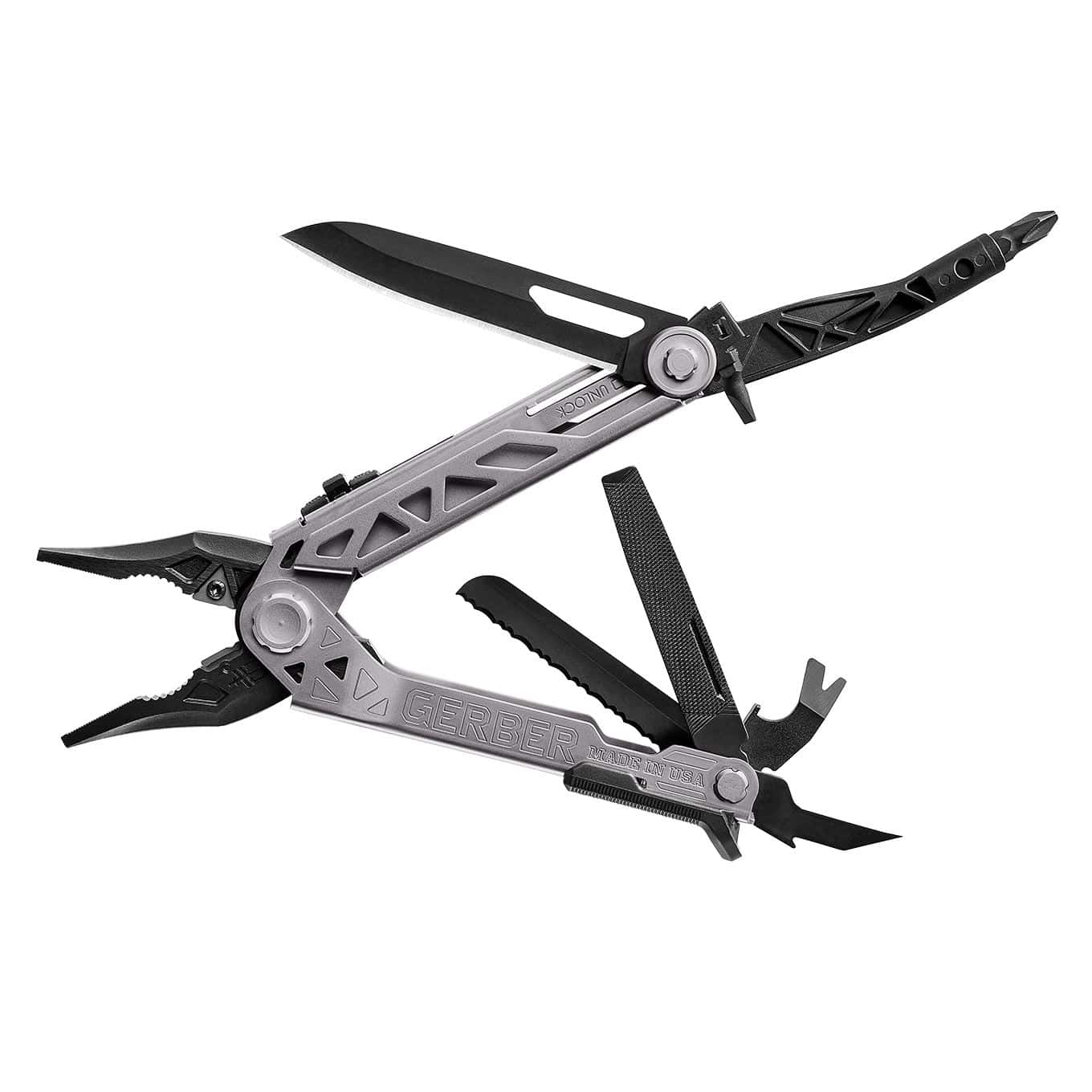
The Center-Drive is our first choice when quick screwdriving jobs are the main reason to carry a multi-tool. Its long driver unfolds toward the center of the handle, giving you a more conventional arrangement than a short driver tucked against the edge of a bulky plier body.
Standard quarter-inch bits are the important buying detail. You can choose the profiles your equipment uses instead of building the whole kit around a proprietary flattened bit. Check that the supplied bit selection covers your actual fasteners; the bundle name alone does not answer that.
The current Bit Set version combines that driver with sliding, spring-loaded needle-nose pliers. It is a substantial tool, and the appeal depends on using the driver often enough to justify carrying it. Our Center-Drive review covers the basic layout.
Reported in use: GearLab’s Kyle Hameister praised the Center-Drive’s driver and one-handed pliers, but found the body cumbersome and several secondary tools awkward to access. That supports a narrow recommendation: buy it for frequent driving, provided you accept the carry bulk.
Key specs: 9.5 oz tool · 4.7 in closed · 3.2 in centered driver · standard 1/4-inch bits
Pros
- Standard quarter-inch bit compatibility
- Long, centered driver arrangement
- Spring-loaded needle-nose pliers
Cons
- Heavier than the compact picks
- No scissors
- Bit kit adds to carry bulk
Skip it if: you need a light pocket tool more than a dedicated-feeling driver.
2. Gerber Dual-Force: Best for a wider gripping range
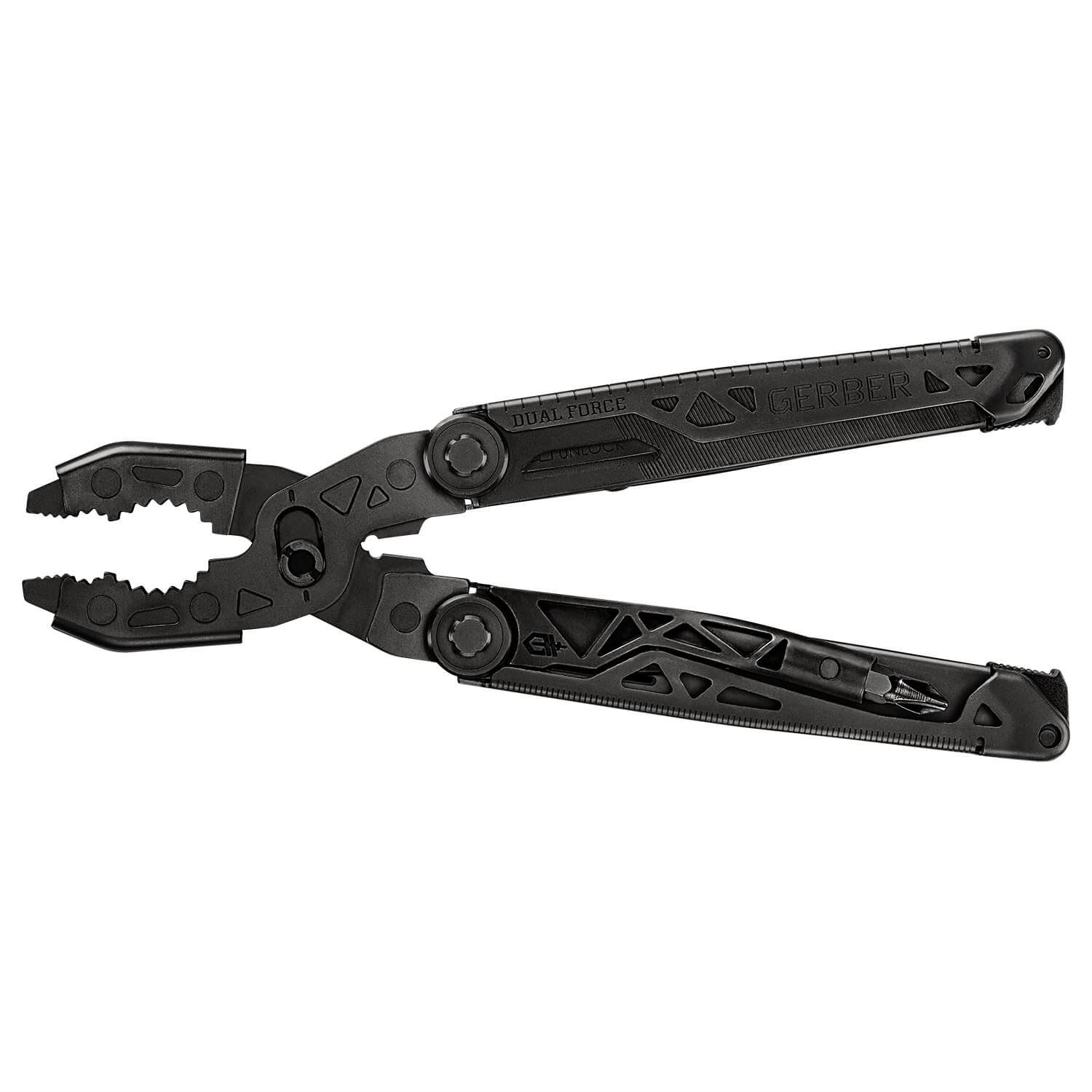
The Dual-Force belongs here for its plier shape. Its adjustable, blunt-jaw design offers a different grip from the narrow needle-nose heads on most folding multi-tools. That makes it worth considering when your recurring jobs involve holding broader parts rather than reaching a tiny component.
Gerber also includes a long centered driver and onboard bit storage. The resulting combination is appealing for general repairs around a vehicle, trailer or workshop, but the broad head is a drawback when access is tight.
This comparison covers the black 1067407 version. We would choose it because the jaw arrangement suits the job, not because of a headline force multiplier. Our Dual-Force review explains the design in more detail.
Reported in use: Knife Informer’s Matt Davidson, a full-time mechanic, valued the Dual-Force’s adjustable grip but missed needle-nose access on some tasks. He also found that his supplied sheath would not close around both the tool and an added bit kit.
Davidson reported one broken onboard bit holder on his review sample. That is a specific durability concern, not a measured failure rate. If you expect to carry several spare bits, check the holder and pouch arrangement during the return window instead of assuming that onboard storage solves the whole kit.
Key specs: 12 oz tool · 4.65 in closed · two-position slip-joint pliers · standard 1/4-inch bit driver
Pros
- Adjustable slip-joint jaw opening
- Standard-bit driver
- Integrated bit storage
Cons
- 12-ounce tool before extra kit
- Broad head limits narrow access
- No scissors
Skip it if: precision access with needle-nose pliers is your main requirement.
3. Leatherman Surge: Best for a broad repair kit
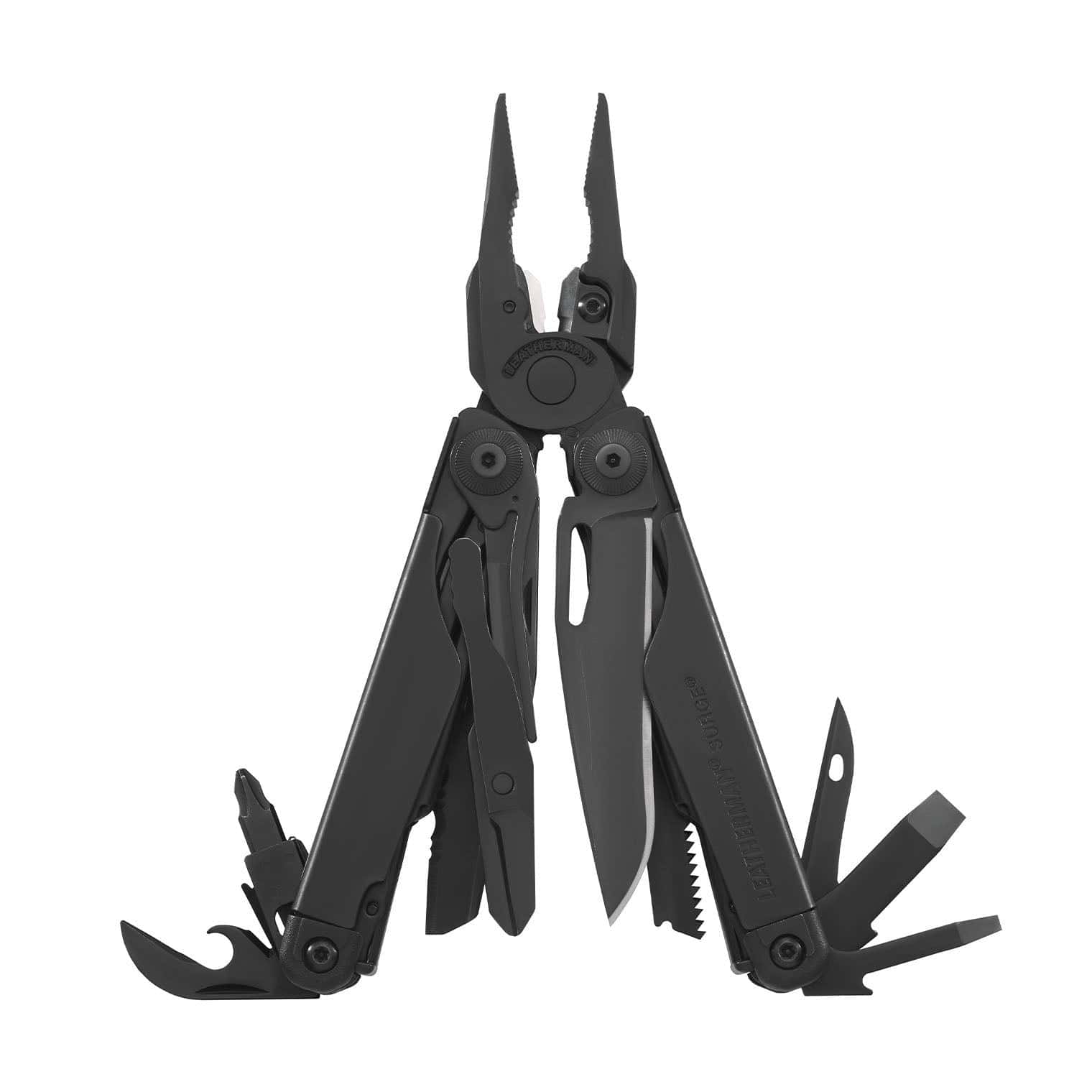
Choose the Surge when scissors, a file and a wider range of implements matter alongside the pliers. It is the pick for someone who wants several repair functions in one sheath and accepts the weight that comes with them.
Its blade exchanger lets the saw and file share a position. That is useful flexibility, but it also creates a loose component to keep with the kit. Think about what needs to be immediately available and what can remain in the pouch.
The current Surge listing sells the sheath separately. Its main bit driver uses Leatherman-format flat bits; standard quarter-inch bits require a suitable adapter. Include those accessories in the budget instead of comparing the bare tool with an already bundled competitor.
Key specs: 12.5 oz tool · 4.5 in closed · 21 tools · 420HC blade · replaceable saw/file arrangement
Pros
- Scissors alongside substantial pliers
- Replaceable wire cutters
- Saw/file exchanger adds flexibility
Cons
- Heaviest bare tool in this list
- Standard bits need an adapter
- Sheath currently sold separately
Skip it if: you will leave a heavy belt tool at home or mostly need one driver.
4. Leatherman Rebar: Best value with fixed drivers
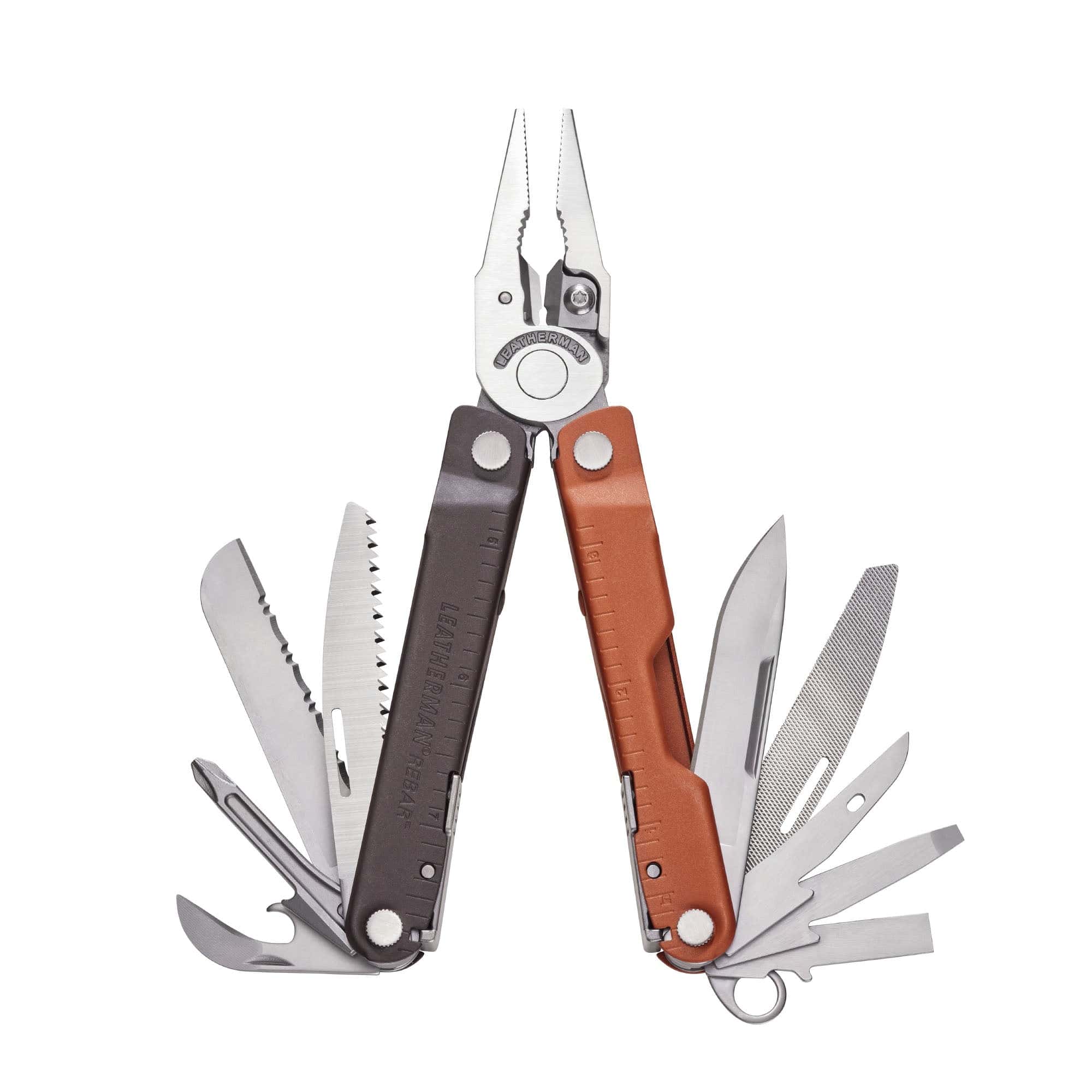
The Rebar is the straightforward choice if its fixed drivers match your regular jobs. You get pliers, replaceable cutters, a file and a saw without committing to a pouch full of bits.
The fixed tips do not cover Torx or hex screws, but the Rebar can be expanded. Leatherman’s Bit Kit #3 includes a Removable Bit Driver compatible with the Rebar. Budget for that adapter if you need interchangeable bits; it is different from the Bit Driver Extender used with a large bit socket.
At the current manufacturer specification, it is substantially lighter than the Surge. It gives up scissors and the large bit socket, and the sheath is now sold separately. Our Rebar review is useful if you prefer this simpler layout.
Key specs: 6.65 oz tool · 4 in closed · 17 tools · 420HC blade · fixed Phillips and flat drivers
Pros
- Lighter than the larger repair tools
- Replaceable wire cutters
- Fixed drivers cannot fall out like loose bits
Cons
- No scissors
- No integrated interchangeable-bit socket
- Sheath currently sold separately
Skip it if: you need several specialist bit profiles during the same shift.
5. Leatherman Skeletool CX: Best for light pocket carry
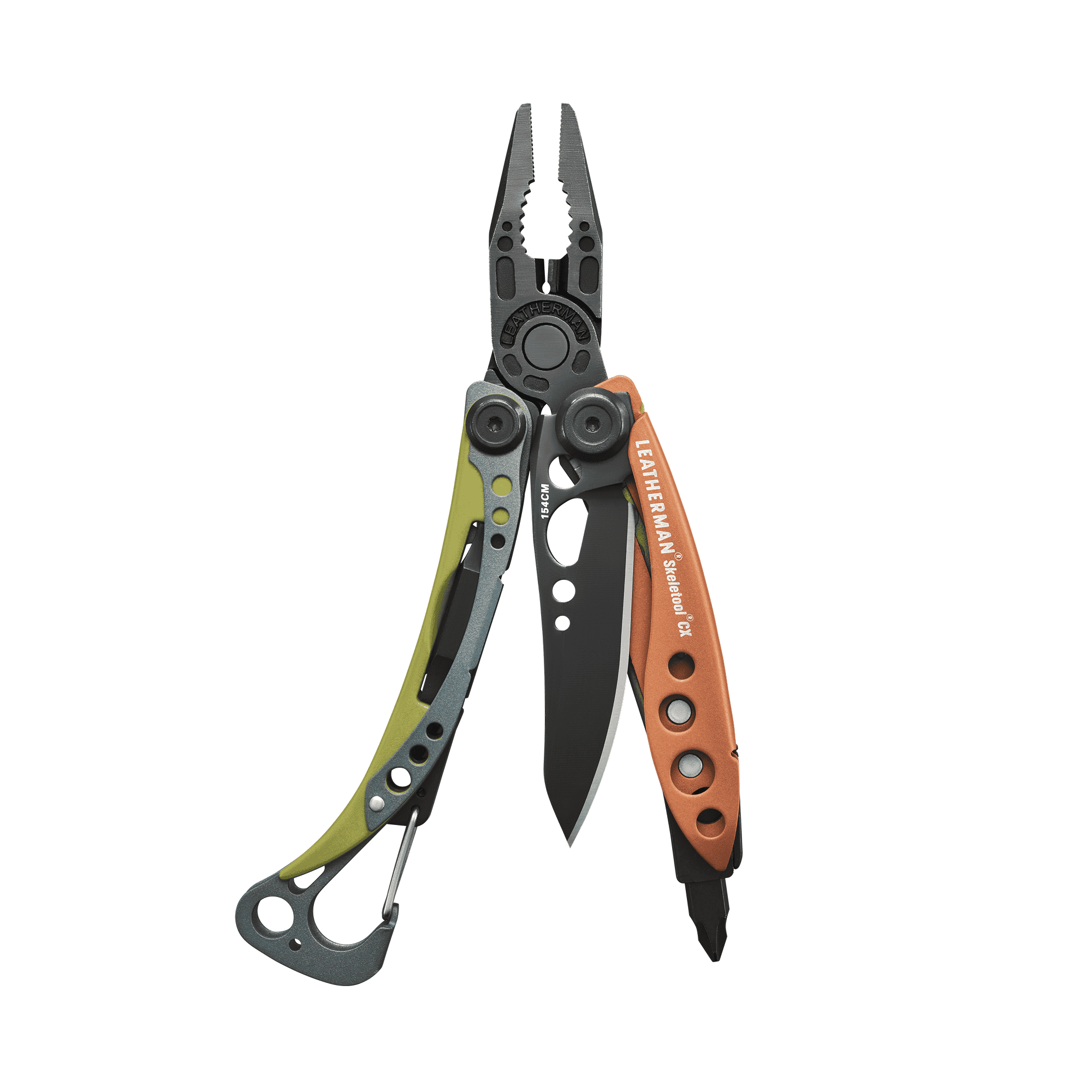
The Skeletool CX is the strongest fit for someone who wants a tool in a pocket every day and already has a proper repair kit nearby. It concentrates on pliers, a blade and an interchangeable driver rather than trying to carry a whole workshop.
That smaller selection is an advantage only if it matches your work. There are no scissors, file or saw. If one of those is the reason you repeatedly reach for a multi-tool, choose a different layout instead of treating the lower weight as an automatic win.
The CX specification includes a 154CM blade and a pocket clip. The driver takes Leatherman flat bits; ordinary quarter-inch bits need an appropriate adapter. The wire cutters are not the replaceable inserts found on the Rebar and Surge.
Key specs: 5 oz tool · 4 in closed · 7 tools · 154CM plain-edge blade · pocket clip
Pros
- Lowest bare-tool weight here
- Pocket clip included
- 154CM plain-edge blade
Cons
- No scissors, file or saw
- Non-replaceable wire cutters
- Standard bits require an adapter
Skip it if: you need a broad tool selection rather than a small companion to your toolbox.
6. Victorinox Swiss Tool Spirit X Plus Ratchet: Best with a separate ratchet
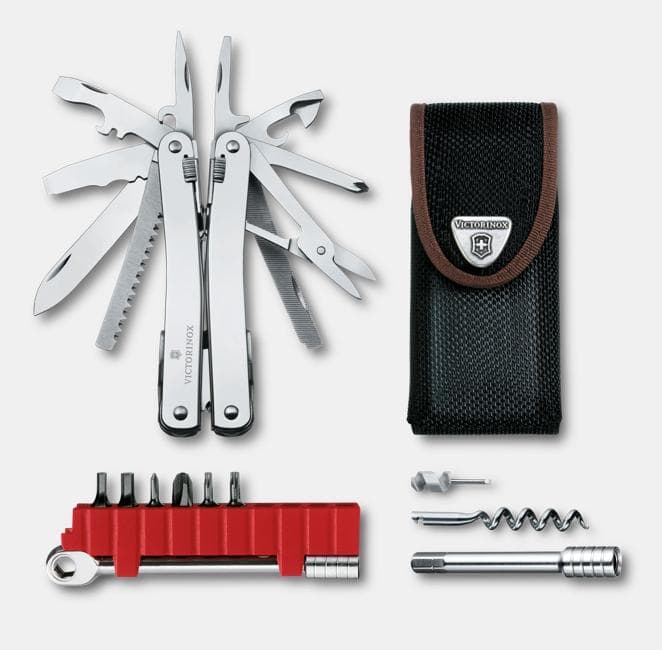
The Spirit X Plus Ratchet takes a different approach: the bit-driving accessory is separate from the folding tool. That arrangement is useful if you want the pliers available while also positioning a driver, without asking one handle to perform both jobs at once.
The tradeoff is organization. You are buying a pouch-based set, with separate parts to put away after the repair. It makes less sense if your priority is retrieving one self-contained tool from a pocket.
The 3.0236.N kit includes the nylon pouch. Victorinox lists 7.4 ounces, but the page does not clearly establish that figure as the weight of the complete ratchet-and-pouch set. We therefore do not rank its fully loaded carry weight against the bare tools above.
Key specs: 4.1 in tool length · nylon pouch included · separate ratchet and bits · 7.4 oz listed weight, kit basis unconfirmed
Pros
- Separate ratchet accompanies the tool
- Scissors, file and saw included
- Nylon pouch supplied
Cons
- Loose accessories to organize
- Highest price band here
- Ratchet is a separate item to retrieve
Skip it if: you want a single pocket item with no separate driver to retrieve.
How we chose these multi-tools
Editor: Brian Hamilton. We compared current manufacturer specifications, driver compatibility and bundle contents, then read published hands-on reviews and owner discussions for practical drawbacks. Named field reports appear beside the relevant picks; individual reports help identify checks to make, rather than establish how often a product fails.
Weight comparisons use the maker’s stated tool weight, with the Victorinox kit ambiguity shown explicitly. Product specifications support the feature comparisons; the best-for labels are editorial judgments about how those features fit different jobs.
Shopping links search for the named model. Check the exact variant, included bits and sheath before ordering, because retailer bundles can differ from the maker’s current offer.
What features matter most for mechanical work?
| Recurring job | Look for | Check before buying |
|---|---|---|
| Turning varied fasteners | Interchangeable bits in the profiles you use | Included bit sizes and whether an adapter is required |
| Reaching a recessed screw | Useful driver reach and clearance | Whether the whole handle fits around the recess |
| Holding broader parts | Jaw opening and gripping shape | A blunt jaw versus needle-nose access |
| Trimming and small repairs | Scissors, file or suitable cutter | The exact implement, not the advertised tool total |
| Carrying all day | Practical weight and attachment | Tool plus sheath, bits and extensions |
Match the actual task before comparing feature counts. No torque rating or electrical insulation is implied.
Begin with a small inventory of your equipment. Write down the screw profiles and sizes you actually encounter, then identify which require a long reach. That short list is more useful than buying a large bit set whose common sizes do not match your work.
A driver can have the right bit and still fail to reach a recessed fastener. Consider the width of the folded handle, the distance from the bit to that handle and whether nearby panels block a straight approach.
Which bit adapter does each multi-tool actually need?
The important distinction is the socket on the tool. Buying a packet of standard hex bits does not make them fit a Leatherman flat-bit socket, and buying the usual socket extender does not give a Rebar that missing socket.
| Tool | To use other bits | Carry consequence |
|---|---|---|
| Center-Drive / Dual-Force | Standard 1/4-inch hex bits fit the built-in driver | Bring the exact profiles and a place for spares |
| Surge / Skeletool CX | Leatherman flat bits fit directly; Bit Driver Extender accepts standard 1/4-inch bits | Extender and spare bits are extra pieces |
| Rebar | Removable Bit Driver, included in Bit Kit #3, adds interchangeable tips | Carry the adapter as well as the bit paddle |
| Spirit X Plus Ratchet | Use the separate ratchet and supplied bit set | Keep the ratchet, bits and plier tool together |
Compatibility checked against the maker pages linked here. An adapter changes reach and packing; it does not supply a torque rating.
Leatherman specifies its Bit Driver Extender for tools with a large bit driver, including the driver type on the Surge and Skeletool CX. The Rebar-compatible removable driver is a separate accessory. Match the accessory name and compatible-tool list before ordering.
Example: your equipment uses PH2, T25 and a 5 mm hex screw. With either Gerber, choose those standard bits and storage. With the Surge or Skeletool CX, choose matching Leatherman flat bits or add the extender. With a Rebar, add its removable driver and the required tips.
The current Bit Kit #3 supplies T10/T15, not T25. A kit can include an adapter and still omit your most-used fastener. Write down the actual sizes before buying, and check recess clearance with the assembled driver.
If you already own a Rebar: price the missing adapter and tips before replacing the entire tool. If you start from scratch and change bits constantly, the Gerbers’ built-in standard-bit drivers remove one accessory from the setup.
Our multi-tool screwdriver guide covers driver-centered choices. Here, include the pliers, loose accessories and carry arrangement in the decision.
How much weight will you actually carry?
The bare Surge weighs 2.5 times as much as the bare Skeletool CX: 12.5 ounces versus 5 ounces in Leatherman’s current specifications. That comparison says nothing about strength; it shows why carry preference can rule out a tool before you compare its implements.
Add the items you intend to bring: pouch, spare bits, extension, ratchet or replacement file. Compare complete carry arrangements where you can, and avoid treating a shipping weight as the weight on your belt.
The Rebar and Surge’s current maker pages list their sheaths separately. The Victorinox kit includes a pouch. Older reviews or retailer bundles may describe different contents, so make the final comparison against what is actually in the order.
What jobs still need dedicated tools?
A folding multi-tool is useful for small adjustments, holding parts and unexpected repairs. It does not replace the specified socket, wrench or torque procedure for a safety-critical fastener. Use the vehicle or equipment manufacturer’s service instructions for that work.
Do not add a cheater bar, strike the handle to free a seized fastener or use a blade as a pry bar. If the required force exceeds controlled use, get the appropriate tool rather than increasing leverage on a folding joint.
None of these picks is presented as an insulated electrical tool. Follow the equipment’s isolation and service procedures; a rubber-looking handle or a wire-stripper function is not an electrical safety rating.
Only if the blade is an important part of your work. The Skeletool CX’s 154CM blade may interest someone who cuts frequently, but it cannot compensate for missing scissors or the wrong driver arrangement.
If pliers and drivers do most of the work, prioritize those first. If carry comfort is the deciding factor, compare the broader selection in our EDC multi-tool guide before buying a heavy tool for functions you rarely use.
Which one should you buy?
Choose the Center-Drive for a standard-bit driver you expect to use frequently. Choose the Dual-Force because its adjustable pliers fit your gripping jobs, or the Surge because you will actually use its broader repair selection.
The Rebar makes sense when its fixed drivers match the task or a removable adapter completes a tool you already own. The Skeletool CX makes sense when low carry weight keeps the tool with you. The Spirit X Plus Ratchet suits a buyer who deliberately wants the driver separate from the pliers.
