The Nitecore NB10000 Gen4 is our lightweight backpacking pick when 39Wh covers your trip. Choose the Anker Zolo A1688 for budget camping, the CARBO 20 for more capacity and fast recharge stops, or the Goal Zero Venture 75 for covered ports and USB-A gear at camp. The NB Air suits a small backup top-up.
On a phone, swipe sideways to compare every column.
| Power bank | Best use | Capacity | Weight | USB-C out / in | Protection | Price band |
|---|---|---|---|---|---|---|
| Nitecore NB10000 Gen4 | Lightweight backpacking | 10,000mAh equivalent; 39Wh | 143g / 5oz | 22.5W / 22.5W | IPX7 | $$$ |
| Anker Zolo A1688 | Budget camping | 10,000mAh; Wh not confirmed | 212g / 7.5oz | 30W / 20W | No IP rating confirmed | $ |
| Nitecore CARBO 20 | Larger reserve; fast recharge stops | 20,000mAh equivalent; 76Wh rated | 320g / 11.3oz | 65W / 65W | IPX8 | $$$$ |
| Goal Zero Venture 75 | Rugged camp use; quick wall refills | 19,200mAh equivalent; 71.04Wh | 577g / 20.4oz | 60W / 60W | IP67 with door closed | $$$$ |
| Nitecore NB Air | Short-trip backup | 5,000mAh; 19.4Wh | 89g / 3.1oz | 18W / 18W | IPX7 | $$ |
Manufacturer specifications checked November 2026; weights exclude separate cables and chargers. Wattages are maximum single-port figures. The NB10000 Gen4, CARBO 20 and Zolo each share 15W across simultaneous outputs. Price bands: $ under $35; $$ $35–60; $$$ over $60–100; $$$$ over $100. Water ratings do not mean you can charge wet equipment.
These are portable USB batteries for phones, rechargeable lights, cameras and similar gear. For mains-powered appliances, start with our portable power-station guide. A bigger mAh label alone cannot tell you whether a bank will cover your trip.
What size power bank do you need for camping?
Count the energy you expect to put back into your devices between dependable charging stops. A weekend spent mostly offline can need much less than a weekend filming, navigating and sharing a bank between two people. The planner includes other gear, conversion losses and an extra energy allowance.
Compare the printed Wh capacity with this target. The 71.04Wh Venture 75 and 76Wh CARBO 20 clear this estimate. A single 39Wh bank does not.
Planning estimate at 65% end-to-end efficiency, rounded up to the next Wh. Actual results depend on your bank, devices, temperature and use while charging.
Default: one 20Wh phone, three days, a 50% refill per day, 5Wh of other-device refills, 20% extra energy and 65% efficiency. Inputs describe energy you need to add during the trip; start with charged devices.
| Planned refills | Device energy | Bank needed |
|---|---|---|
| Day hike: 25% phone refill | 5.0Wh | 10Wh |
| Two days: 40% per day + 3Wh for other gear | 19.0Wh | 36Wh |
| Three days: 50% per day + 5Wh for other gear | 35.0Wh | 65Wh |
| Two phones, three days: 50% each per day + 10Wh other gear | 70.0Wh | 130Wh |
Find your phone’s battery energy: use its manufacturer’s Wh specification. If you only have mAh, multiply by the battery’s nominal voltage and divide by 1,000; do not substitute the USB port’s 5V. A 20Wh phone is an example, not a specification for every phone.
Enter the percentage you expect to refill each day: 50% means half a full battery, while 150% means one and a half. “Other-device refills” covers the whole trip, not each day. For example, adding one full charge to a 5Wh headlamp battery adds 5Wh; three such refills add 15Wh.
The default assumes 65% of the bank’s stored energy reaches device batteries. Try 55% for a larger loss allowance or 75% for a more optimistic estimate. These are adjustable planning assumptions, not measured efficiencies or guaranteed limits; old batteries, cold conditions and devices running while charging can perform worse.
The extra 20% is additional energy above the planned refills, not a promise that the bank finishes at 20% charge. Start with charged devices, and round up to a bank whose printed Wh meets the result. Test your actual phone, cables and lights before relying on the plan away from power.
Why 10,000mAh does not mean two full phone charges
Milliamp-hours describe charge at a particular voltage. A power bank’s cell rating and its USB output rating use different voltages, and energy is lost while converting power and charging your phone. Watt-hours put the stored energy on a common basis, though they still do not remove those losses.
The NB10000 Gen4 specifications show this clearly: 39Wh of cell energy, but a rated 6,800mAh at 5V under the stated 3A load. That output figure equals 34Wh, before the phone’s own charging losses. Neither number should be presented as a field-tested phone-charge count.
A conservative example: with a 20Wh phone and 65% end-to-end efficiency, 39Wh gives about 1.3 full-charge equivalents; 76Wh gives about 2.5. The 19.4Wh NB Air gives about 0.6. These calculated examples use no extra trip reserve and change with the phone, bank and charging conditions.
A partial refill still counts. Charging from 30% to 80% is roughly half a charge, so several top-ups do not necessarily mean several full charges. Download maps before leaving, reduce unnecessary screen use and allow for the extra consumption of navigation, photography and weak-signal searching.
Our five camping and backpacking power-bank picks
1. Nitecore NB10000 Gen4: Best for lightweight backpacking
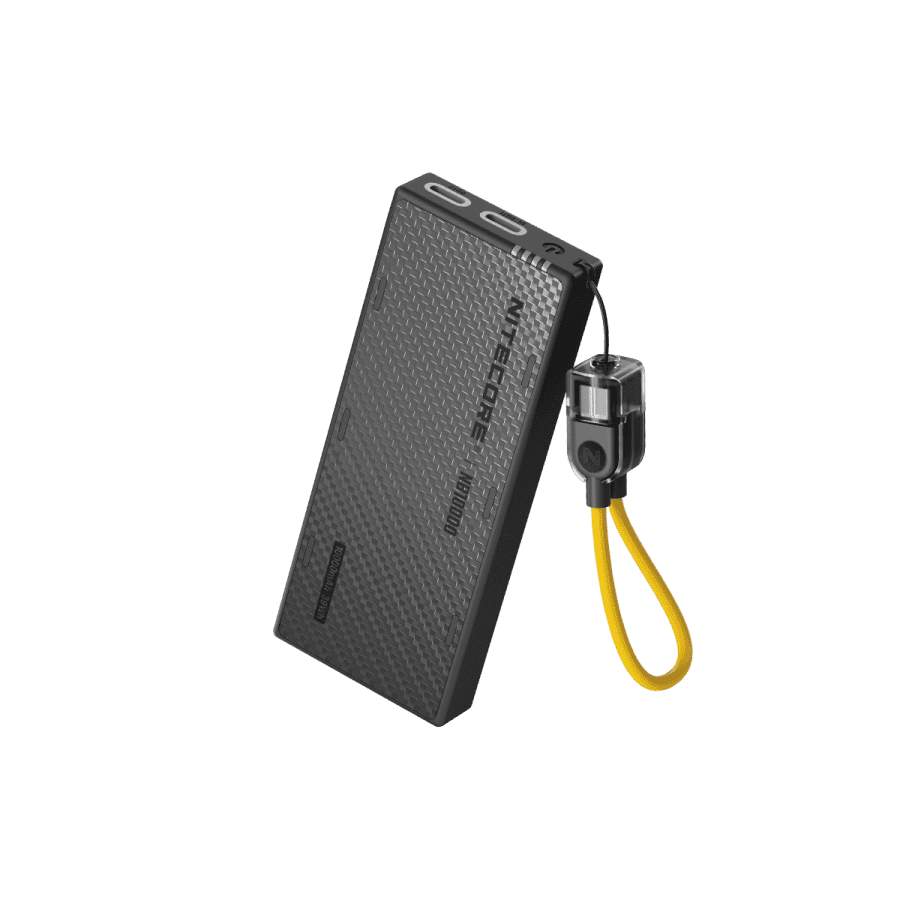
The Gen4 makes sense when you want useful phone capacity without carrying a general-purpose laptop battery. Its 143g body contains 39Wh, with two USB-C outputs and a compact shape. Choose it because your energy budget fits, not because “10,000mAh” sounds sufficient for any weekend.
There is a useful distinction between its sockets: the Gen4 manual identifies USB-C IN/OUT1 for recharging the bank. Both sockets can power devices, but connecting two devices reduces total output to 15W. Neither gets its advertised maximum independently in that arrangement.
The same manual describes an Eco mode limited to 5V/1A. That is an option for slower charging, not proof that every headlamp or watch will charge correctly. Check your small devices at home, including whether charging continues after their initial connection.
IPX7 is welcome protection against an accidental dunk; it does not make this an underwater charger. Nitecore specifically says to dry it thoroughly before use after immersion. Keep the bank and connectors sheltered while charging, and include the supplied lanyard cable when weighing your complete kit.
Key specs: 39Wh · 143g before accessories · 116 × 46.8 × 14.5mm · two USB-C outputs · 22.5W maximum input and single output.
Pros
- Low weight for its stored energy
- Two USB-C outputs for compatible gear
- IPX7 rating and included lanyard cable
Cons
- Costs more than the budget Anker
- No built-in USB-A socket
- Two-device output is limited to 15W total
Skip it if: the planner calls for more than 39Wh between charging stops, or you want an inexpensive bank mainly for car camping.
2. Anker Zolo A1688 10K: Best budget option
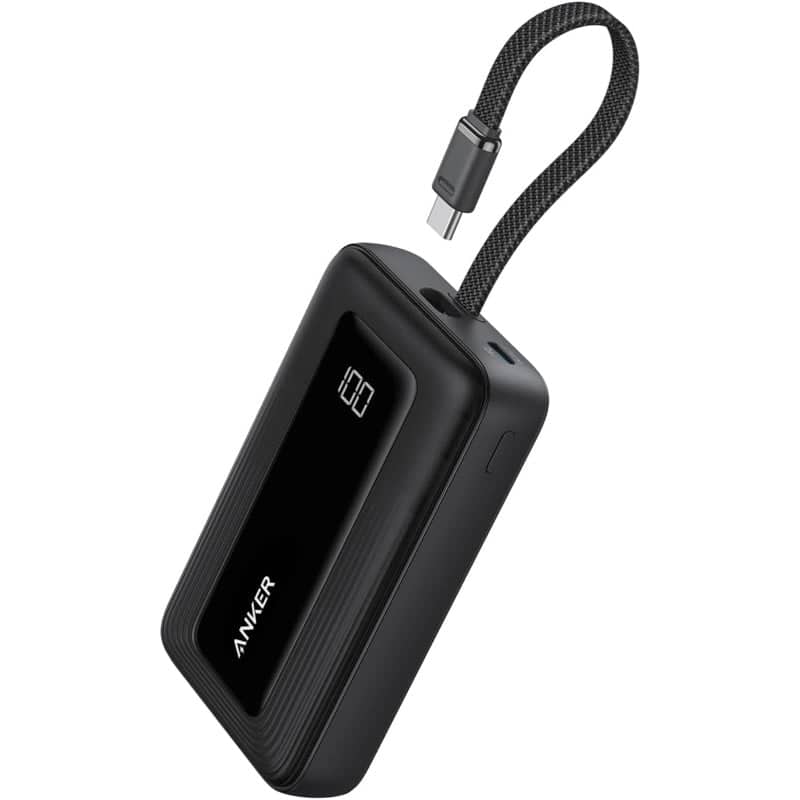
The Zolo is our lower-cost choice for ordinary camp charging when saving every gram is less important. Its built-in USB-C cable means one frequently used lead is already attached, while separate USB-C and USB-A sockets provide alternatives. The percentage display is easier to interpret than a row of four lights.
Match the A1688 10K model, rather than buying by the Zolo name alone. Anker uses similar names across capacities and connector arrangements. A built-in USB-C lead also will not directly charge an older Lightning iPhone; bring the correct separate cable.
The detailed manufacturer specifications list 30W USB-C output but only 20W input. Anker estimates about 2.5 hours to refill it with a suitable 20W charger. A higher-powered wall charger cannot turn that 20W input into a 30W refill.
The A1688 manual limits combined output to 15W, so charge devices separately when speed matters. Its specifications give 10,000mAh without a Wh value; check the unit’s label before comparing it with the planner. We have left that figure unconfirmed rather than assuming every 10K bank stores 39Wh.
Its attached cable is convenient, but it is another part to protect from snagging and repeated strain. The separate sockets give you a way to use a spare cable. We could not confirm an IP rating, so carry it in dry storage and charge under shelter.
Key specs: 10,000mAh · about 212g · about 109 × 65 × 25mm · attached USB-C cable, USB-C socket and USB-A socket · 30W maximum USB-C output; 20W input.
Pros
- Lowest price band in this shortlist
- Attached USB-C cable plus separate sockets
- Percentage display and low-current mode
Cons
- Heavier than the 10K Nitecore
- No confirmed weather-protection rating
- Input is slower than its maximum output
Skip it if: your priority is the lightest pack, a documented immersion rating or a built-in Lightning connector.
Check the exact model before buying used or packing an older bank. Anker’s recall notice includes Zolo A1681 and A1689, among other models; the A1688 selected here is a different product. The older PowerCore A1263 also has a recall. Follow the manufacturer’s model and serial-number checks; do not keep using a recalled unit.
3. Nitecore CARBO 20: Best larger bank for fast recharge stops
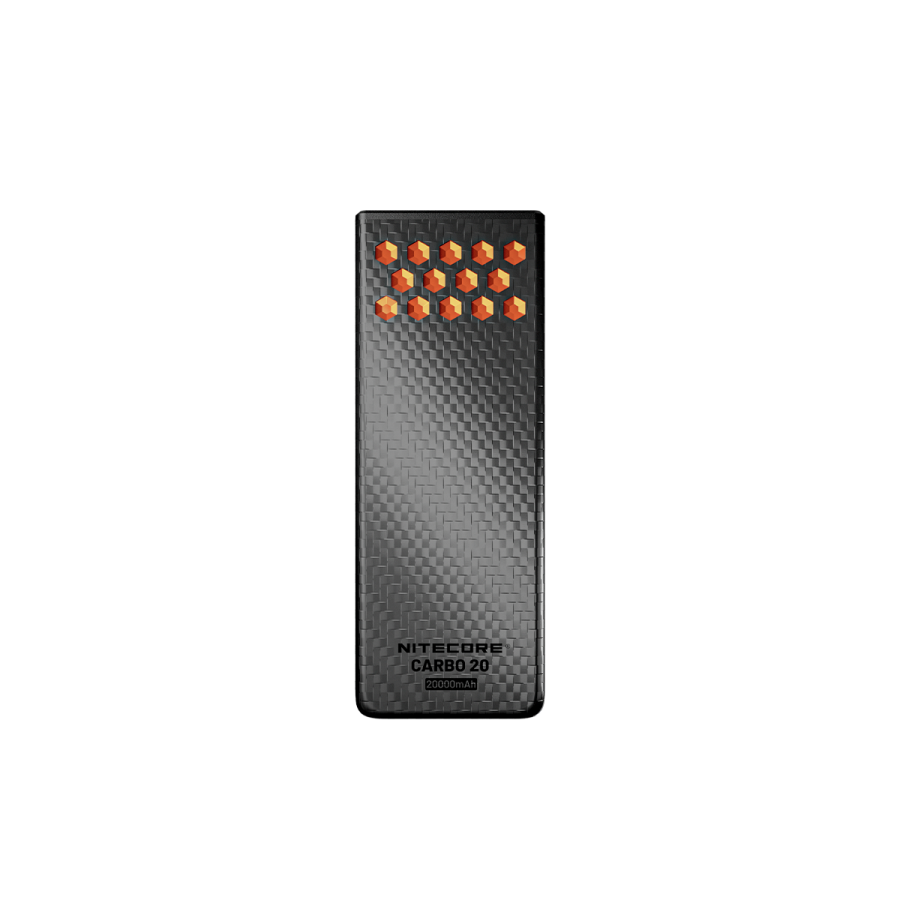
The CARBO 20 earns its place when you need a larger reserve and can recharge during a town or campsite stop. Its 65W input is a substantial step up from the NB20000 Gen3’s 18W limit, for a 29g increase in body weight. That advantage matters less if you never recharge during the trip.
Nitecore specifies 76Wh rated capacity and 77.6Wh typical capacity; we use the lower 76Wh in the planner. The percentage screen makes remaining charge easier to read. Its IPX8 rating adds immersion protection, but Nitecore still requires completely dry ports before charging or discharging after exposure to water.
Use a compatible USB-C PD charger rated for at least 65W and the supplied cable for fast refills. The manual identifies IN/OUT1 as the charging input. Both ports support up to 65W individually, but two connected devices share just 15W; pass-through output is also limited to 15W.
Two NB10000 Gen4 bodies total 78Wh and 286g before accessories, giving separate reserves at less weight. Recharging both at once needs suitable leads and charger outputs; compare the complete kit with the CARBO 20 setup. Peak watts alone cannot promise a full refill during a short stop.
Key specs: 76Wh rated · 320g before accessories · 128 × 48 × 29mm · two USB-C ports · 65W input/single output; 15W shared · IPX8.
Pros
- 65W input suits short charging opportunities
- Larger reserve with a percentage display
- IPX8 rating and USB-C cable included
Cons
- Highest checked price in this shortlist
- Two-device output drops to 15W total
- Heavier than two NB10000 Gen4 bodies
Skip it if: you will not recharge during the trip and mainly want inexpensive phone capacity. The 72Wh, 291g NB20000 Gen3 is a cheaper alternative if its 18W input and IPX5 rating meet your needs.
4. Goal Zero Venture 75: Best for rugged camp use
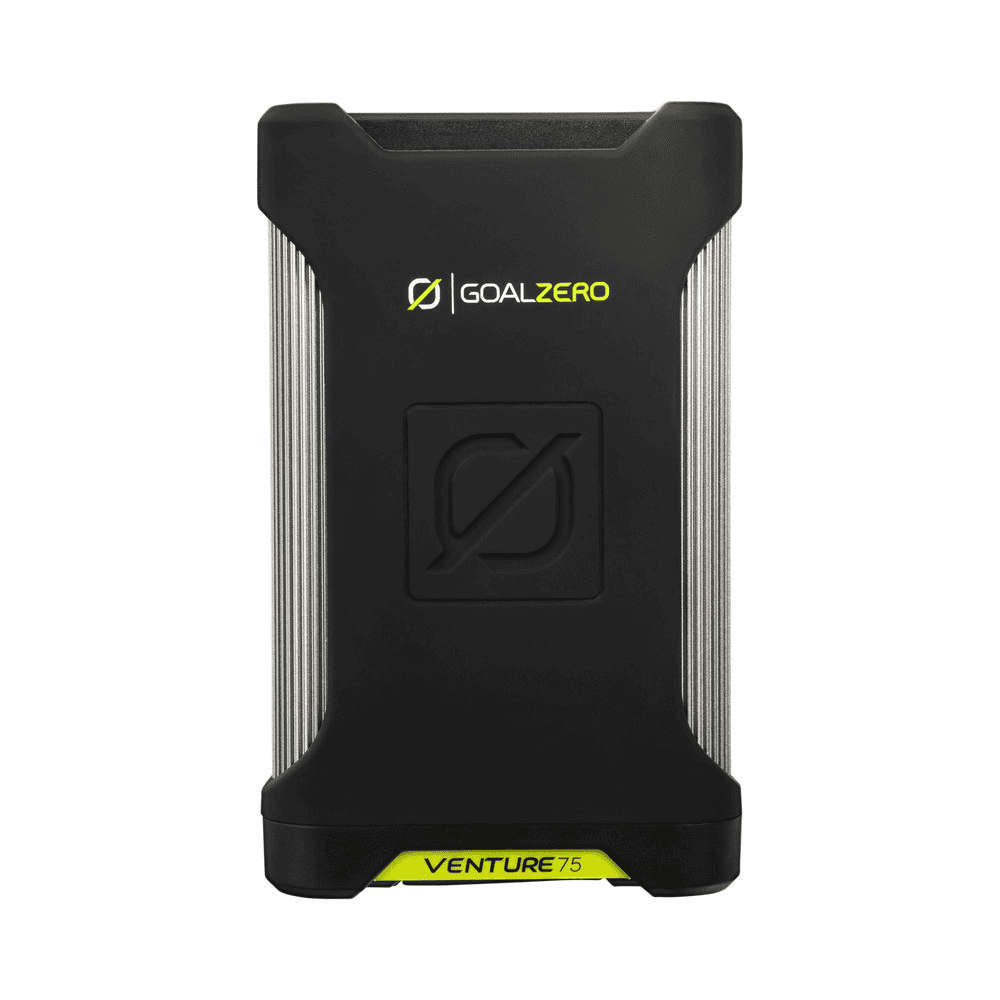
The Venture 75 suits a base camp where covered ports, older USB-A gear and fast wall refills matter more than carrying weight. Its rubber sleeve and closed port door protect the bank in storage. Choose it over the CARBO 20 for that port arrangement and documented dust protection, rather than a weight advantage.
Goal Zero specifies 71.04Wh, a 577g weight, two USB-A outputs and a bidirectional USB-C port. It lists a 1.5-hour refill using 60W USB-C PD. Treat that as a manufacturer estimate requiring a compatible charger and cable, rather than a result to expect from a basic USB-A adapter.
The IP67 rating applies with the waterproof door fully closed. Opening it to plug in a device changes the protection situation: arrange a sheltered, dry charging spot. The 60W port can serve compatible USB-C gear, but the bank’s capacity still determines how long that gear can run.
For backpacking, its penalty is hard to ignore: 257g more than the CARBO 20, with less stored energy. The NESTOUT 15,000mAh is a cheaper, roughly 365g alternative with two USB-A ports, but its 18W input favors overnight refills. The Venture’s reason to pay and carry more is faster recharging plus covered ports.
Key specs: 71.04Wh · 577g · 156 × 96 × 29mm · one 60W USB-C input/output and two USB-A outputs · IP67 with door closed · integrated 50-lumen light.
Pros
- Fast USB-C input for supported wall chargers
- Dust and water protection with ports closed
- USB-A sockets suit older charging cables
Cons
- Heaviest bank in this shortlist
- Port door must open for charging
- Expensive if you only need phone charging
Skip it if: you are carrying all your gear on foot and primarily need lightweight phone backup.
5. Nitecore NB Air: Best for a small backup top-up
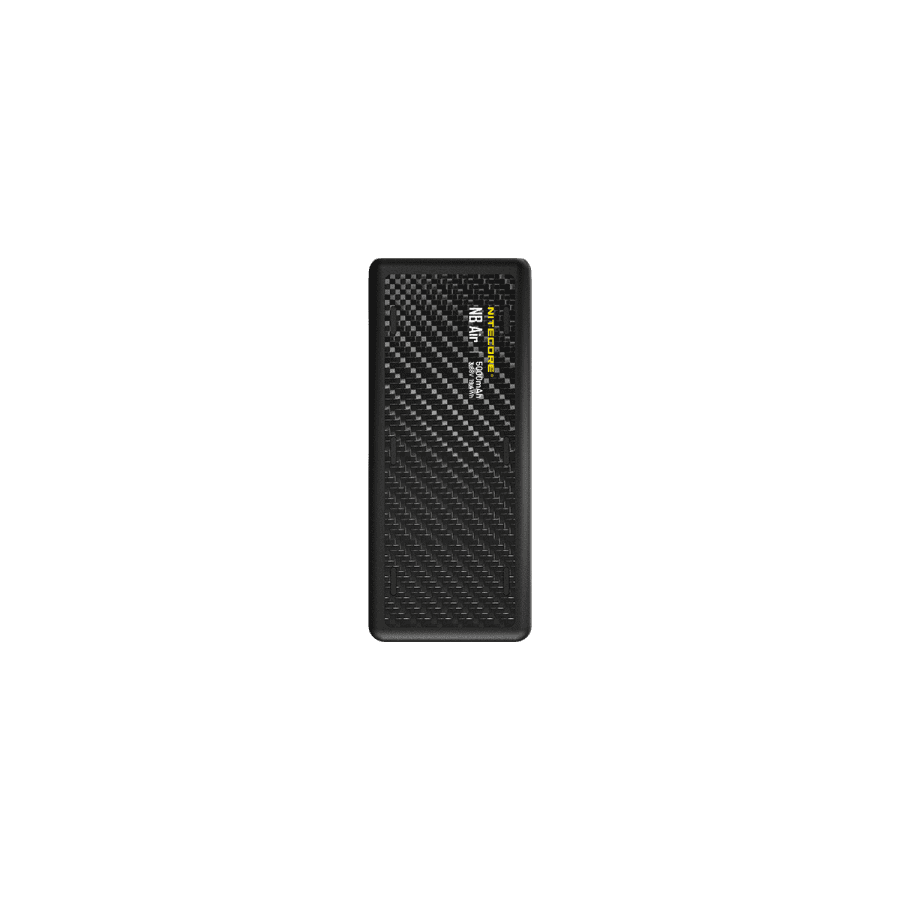
The NB Air is for a day hike, a short outing or a modest backup alongside already charged devices. Its 89g body and 19.4Wh capacity save weight by carrying less energy. That is a sensible choice only when you have deliberately planned for fewer refills.
Nitecore lists one USB-C port, up to 18W input/output and an IPX7 rating. There is no second socket to charge a phone and light together. A single-port bank also gives you fewer options if a connector gets damaged or stops making reliable contact.
Do not translate the 5,000mAh label into a guaranteed refill of a 5,000mAh phone. In our conservative 20Wh-phone example, this is roughly a 60% refill. Smaller batteries and different losses change the result, but navigation-heavy multi-day use quickly exceeds its purpose.
It can also be a separate reserve for a small device if you have checked compatibility. If both your phone and headlamp draw from it unexpectedly, your original energy budget no longer applies. Nitecore supplies no charging cable, so bring the correct one and include its weight.
Key specs: 19.4Wh · 89g · 112 × 48 × 9.7mm · one USB-C input/output · 18W maximum · IPX7.
Pros
- Lightest and thinnest option here
- Enough for a planned small top-up
- IPX7 rating in a compact body
Cons
- Limited energy for modern phones
- Only one charging socket
- Poor fit for several demanding days
Skip it if: you need a guaranteed full refill of a large phone, several days of charging or simultaneous outputs.
What to look for before choosing a power bank
| Your situation | Prioritize | Check before buying |
|---|---|---|
| Walking with everything on your back | Enough Wh at a low complete-kit weight | Bank plus cables, adapters, dry storage and any wall charger |
| Several people sharing | Total energy and usable sockets | Shared-output limit; whether separate banks would avoid a single failure |
| Short stops near mains power | Input wattage and a compatible wall charger | Output wattage is not necessarily the bank’s refill speed |
| Rain, dust or paddling trips | Documented protection and dry transport | Port-cover conditions; a dry place to charge after opening it |
| Headlamps, watches or earbuds | Connector and low-current compatibility | A full charging trial; the right charging lead or dock |
| A phone plus an electric blanket or heater | The appliance’s actual input and energy demand | Many 12V or AC products cannot run from these USB banks |
Buy for the devices you own. A powerful USB-C port does not automatically provide every voltage or charging protocol a laptop, heated garment or camera expects. Check the device’s input requirements and cable rating; for bigger loads, our heated-blanket guide separates USB, vehicle and mains-powered options.
How should you recharge phones and headlamps at camp?
Bring the cable for every connector you actually use, including a watch dock or camera lead if needed. Before departure, charge each device from the chosen bank long enough to confirm that the battery percentage rises. A plug fitting the socket does not establish successful charging.
Small devices may draw too little current to keep some banks awake. The A1688 manual instructs you to double-press its button, then use the USB-A port for trickle charging. For a camping headlamp, also check whether it charges internally or requires a separate battery charger.
Recharge the bank with a suitable USB-C wall charger before leaving. At a campsite, the charger, cable and bank must all support the intended input; sharing a multi-port wall charger can reduce what each output supplies. The final part of charging often slows, so do not schedule a refill around peak watts alone.
Using power banks in cold or wet weather
Keep batteries and sockets dry, protected from crushing and away from direct sun or a hot parked vehicle. An IP rating is not permission to connect wet plugs. The Gen4 manual requires thorough drying after immersion, and the Venture 75’s rated protection depends on its door being closed.
Follow the exact model’s operating and charging temperature instructions. The A1688 safety sheet specifies operation from 32–95°F (0–35°C); Goal Zero lists 32–113°F (0–45°C) for the Venture 75. Do not assume a bank rated for cold discharge is also approved for charging below freezing.
Let cold equipment return to a permitted temperature naturally before charging, and check for condensation. Do not heat a bank beside a stove or fire. Stop using a swollen, leaking, damaged or unusually hot bank, and follow the maker’s instructions for safe handling and disposal.
Should you bring a solar charger instead of more battery?
A separate solar panel can help on longer trips with dependable sun and time to set it up. Its rated watts are not a promise of all-day output: shade, angle, weather and short daylight reduce what you collect. Include the panel and cables in your weight comparison.
For a short trip, another charged bank is often easier to plan around than uncertain solar input. For longer stays, compare compatible panels in our camping solar-panel guide. Keep the bank shaded, dry and within its temperature limits while the panel sits in the sun.
How we chose these power banks
Our editorial team, with Brian Hamilton as editor, compared current manufacturer specifications, manuals, store listings and recall notices. We prioritized clearly different uses: an inexpensive camp bank, low backpacking weight, larger capacity with fast refills, protected camp storage and a small backup.
This is a research-based shortlist; the charge estimates are calculations rather than our own discharge tests. We distinguish peak input from output, stored energy from rated USB energy, and weather ratings from safe charging conditions. Manufacturer phone-charge claims are not treated as interchangeable measurements.
We excluded recalled model numbers from the shortlist and kept large AC power stations outside this page’s purpose. Check the exact generation, connector layout and current manufacturer recall information before ordering. The right choice is the smallest practical kit that covers your planned refills with room for uncertainty.
